Jute Bags vs Cotton Bags: Which Is Better for Your Brand?
-

17th Jul, 2026
-
(0)


By : Sara International
Most comparisons between jute bags vs cotton bags focus on sustainability. That is where many buyers get the decision wrong. The UK Environment Agency’s life cycle assessment of supermarket carrier bags found that a cotton bag needs 131 reuses before it beats a single use HDPE bag on global warming potential. How often people use a bag matters more than the plant it comes from.
That one number changes the way you should look at the decision. A beautiful bag that nobody uses has a bigger environmental cost than a plain bag that stays in a car boot for four years. So the real question is not which fibre performs better in a lab. It is which fibre produces a bag your customer picks up again next week.
This guide compares both materials on cost, print quality, durability, compliance risk, and freight, using the same numbers buyers ask for during sourcing calls.
Jute Bags vs Cotton Bags: The Short Answer
Jute is stronger, costs less as a raw material, and has a lower cultivation footprint. Cotton prints better, offers more colour choices, is washable, and weighs less during shipping. Neither material is better in every situation. In most cases, your design decides which one makes more sense.
| Factor | Jute | Cotton Canvas |
|---|---|---|
| Texture and look | Coarse, rustic, natural golden brown | Smooth, uniform, accepts dye in any colour |
| Structure | Holds its shape without added weight | Needs a heavier fabric weight to feel substantial |
| Print detail | Best for bold one or two colour designs | Supports fine details, gradients, and full-colour printing |
| Washability | Spot clean only | Machine washable on a gentle cycle |
| Water at cultivation | Low, largely rain-fed | High for conventional, lower for organic |
| Typical load capacity | 8–12 kg at 300 GSM | 15 kg or more at 12 oz |
| Lifespan under heavy use | 2–4 years | 4–8 years |
| Freight weight | Heavier per unit | Lighter per unit |
| Certification route | No recognised organic fibre certification | GOTS and OEKO-TEX certifications available |
| Fabric cost | Lower | Higher |
If your logo is a single-colour wordmark and the bag needs to stand upright on a market stall, buy jute. If your artwork includes gradients, fine type, or photography, go for cotton canvas without a second thought.
What Each Fibre Actually Is
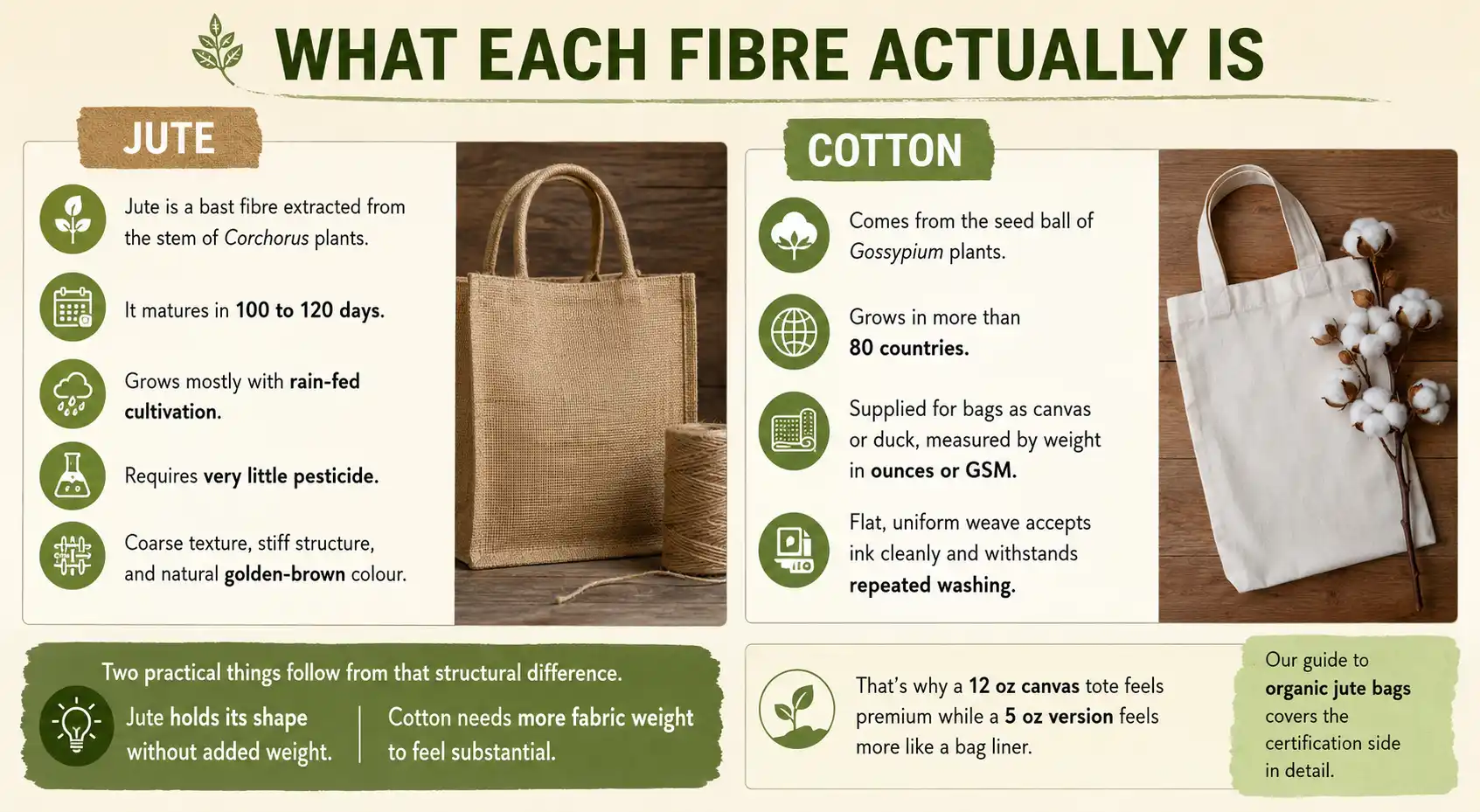
Jute is a bast fibre extracted from the stem of Corchorus plants, grown almost entirely across the Ganges delta in India and Bangladesh. It matures in 100 to 120 days, grows mostly with rain-fed cultivation, and requires very little pesticide. The fibre has a coarse texture, a stiff structure, and a natural golden-brown colour.
Cotton comes from the seed ball of Gossypium plants and grows in more than 80 countries. Manufacturers supply it for bags as canvas or duck, measured by weight in ounces or GSM. Its flat, uniform weave accepts ink cleanly and withstands repeated washing.
Two practical things follow from that structural difference. Jute holds its shape without added weight. Cotton needs more fabric weight to feel substantial, which is why a 12 oz canvas tote feels premium while a 5 oz version feels more like a bag liner. Our guide to organic jute bags covers the certification side in detail.
The Sustainability Comparison, With The Numbers
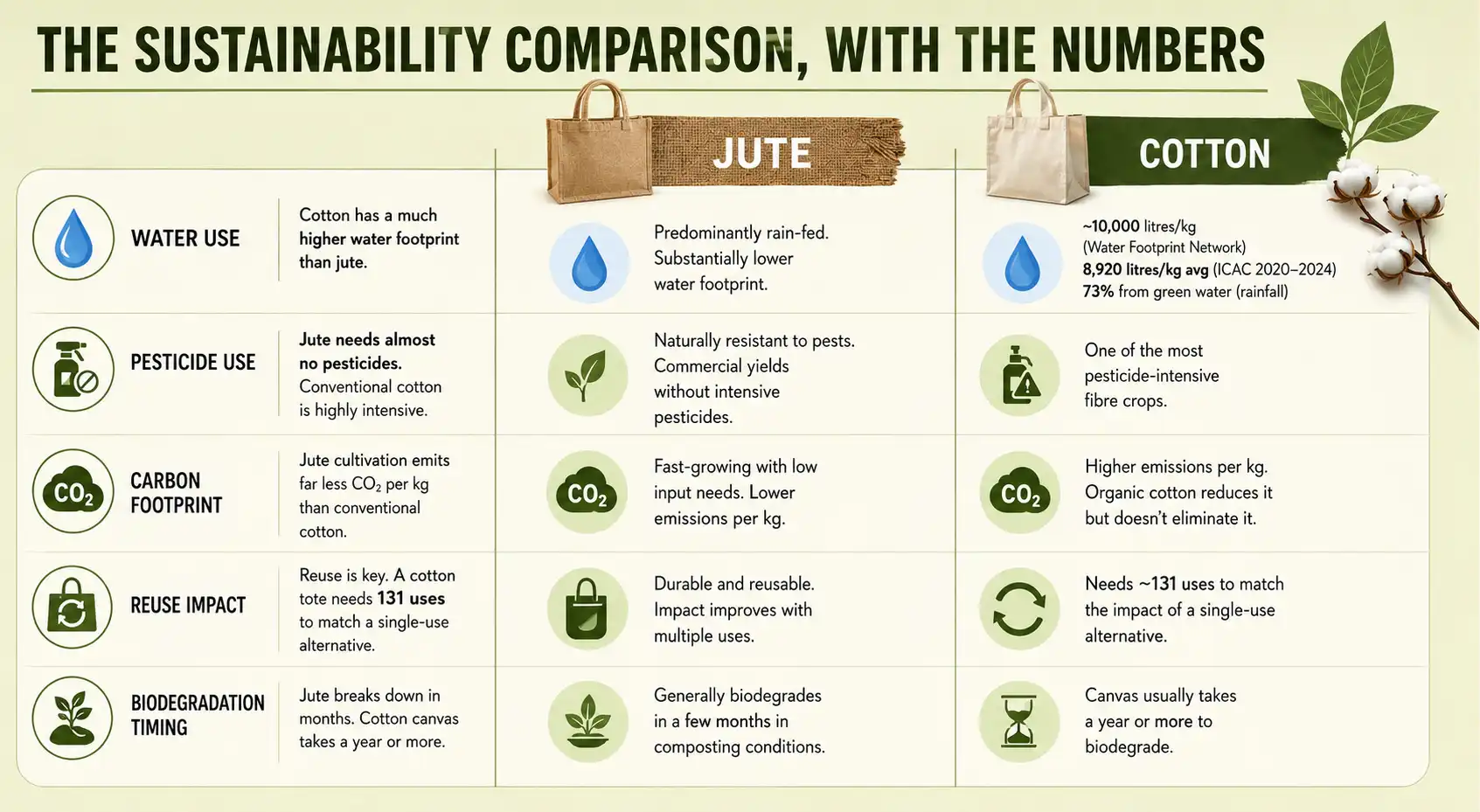
Water use is where the gap opens the widest. Cotton cultivation has long been associated with a water footprint of around 10,000 litres per kilogram of fibre, according to the Water Footprint Network. A more recent ICAC assessment covering 2020–2024 places the global average at 8,920 litres per kilogram, with 73% supplied by green water (rainfall) rather than irrigation. Jute, as a predominantly rain-fed fibre crop, has a substantially lower water footprint.
Pesticide use is the other clear difference. Jute’s natural resistance to pests allows growers to achieve commercial yields without intensive pesticide applications. Conventional cotton sits at the opposite end of the spectrum and remains one of the most pesticide-intensive fibre crops. That is one of the reasons standards such as GOTS promote certified organic cotton production.
The carbon footprint follows a similar pattern. Jute is a fast-growing annual fibre crop with relatively low input requirements, so its cultivation emissions per kilogram remain well below those of conventional cotton. Organic cotton narrows the gap by eliminating synthetic fertilizers, although it does not eliminate it completely.
Reuse, however, changes the equation. A cotton tote bag needs around 131 uses before its environmental impact equals that of a single-use alternative. A cotton bag distributed at an event and used only a few times delivers little environmental benefit, regardless of how the cotton was produced.
Biodegradation timing differs too. An uncoated jute bag generally biodegrades within a few months under industrial or home composting conditions. Cotton canvas usually requires a year or more. Our post on disposing of jute and cotton bags responsibly explains the end-of-life options for both materials.
Where Your Eco Claim Turns Into A Legal Problem
This is the part that most comparisons skip, yet it is also the part that can cost you money. Many jute promotional bags include a polyethylene (PE) lining or biaxially oriented polypropylene (BOPP) lamination. Both make the bag more useful in the rain. Both also make an unqualified biodegradable claim difficult to defend.
The FTC Green Guides take a clear position on this. An unqualified degradable claim is considered deceptive if a product does not completely decompose within one year after customary disposal. The rule also states directly that landfills and incinerators do not provide the conditions needed for complete decomposition within that period. A laminated jute tote does not meet that standard.
Europe is moving in the same direction. Directive (EU) 2024/825, which applies from 27 September 2026, prohibits generic environmental claims that cannot be substantiated. Printing “eco-friendly” on a bag without supporting evidence turns a marketing claim into a compliance risk rather than a competitive advantage.
A defensible claim is a specific one. “Made from 100% uncoated jute, home compostable” is a claim that can be supported with evidence. “Eco-friendly biodegradable bag” is not. Adding specific, verifiable wording at the artwork stage costs nothing and removes the risk of making an unsupported environmental claim.
The practical fix is simple and effective. Ask your supplier to confirm in writing whether the bag is laminated, lined, or coated, and keep that confirmation on file. Uncoated jute and 100% cotton canvas are easier to support with environmental claims. Laminated bags require qualified claims rather than broad, unsubstantiated ones.
Printing And Branding: What Most Orders Actually Turn On
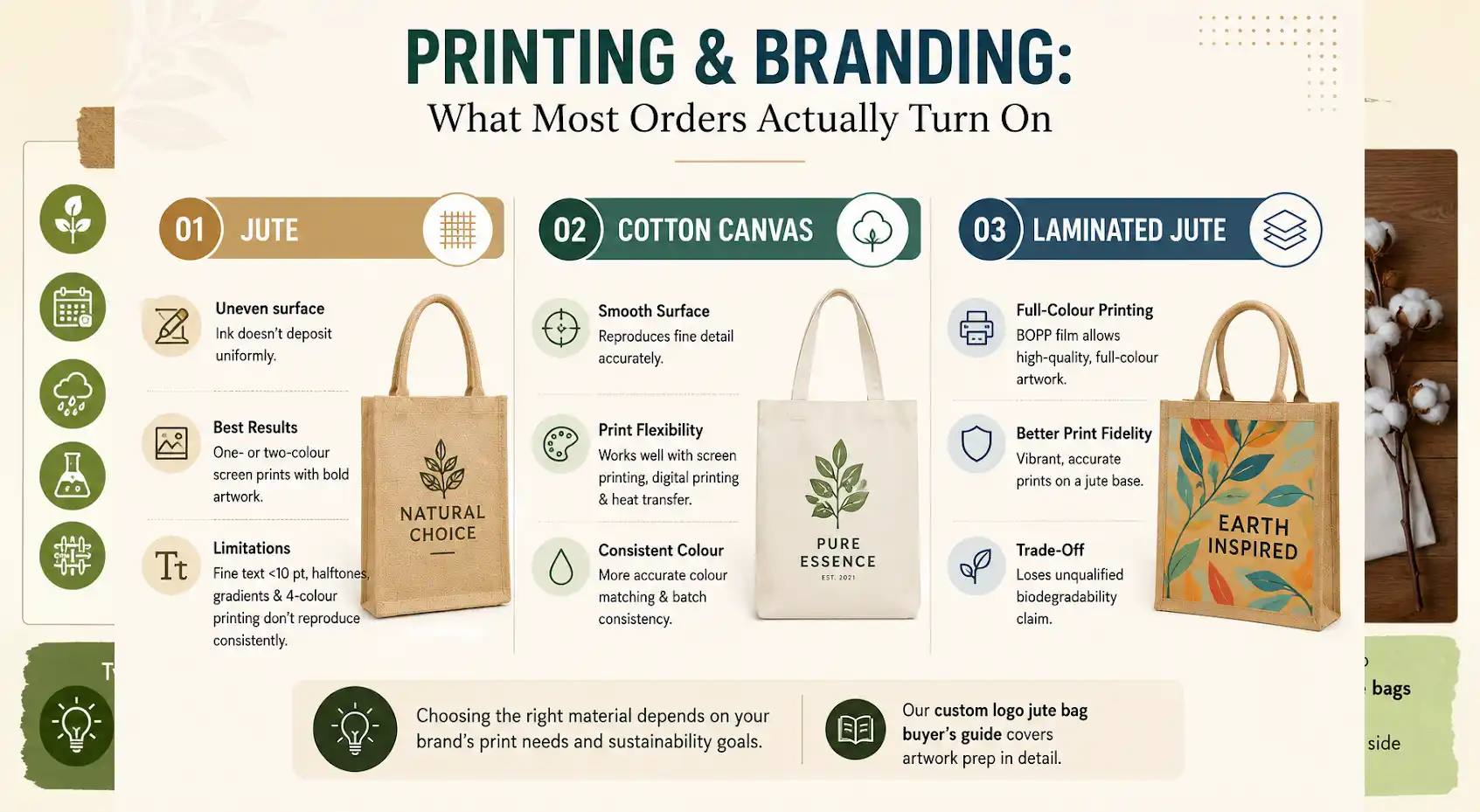
Jute’s surface is uneven at the fibre level, so ink does not deposit uniformly. One- and two-colour screen prints with bold artwork reproduce well, and the natural texture can even complement a rustic brand identity. Fine serif type below 10 pt, halftones, gradients, and four-colour process printing rarely reproduce consistently on the jute surface.
Cotton canvas solves most of those limitations. Its smoother surface reproduces fine detail more accurately, whether you use screen printing, direct-to-fabric digital printing, or heat transfer. Colour also remains more consistent from batch to batch. If your brand guidelines require precise Pantone colour matching, canvas is the safer substrate every time.
There is another option if you want the appearance of jute without giving up print quality. Laminated jute uses a printed BOPP film, allowing full-colour artwork on a jute base. You gain better print fidelity but lose the ability to make an unqualified biodegradability claim. That trade-off makes sense for retail packaging but makes little sense for a sustainability campaign.
Our custom logo jute bag buyer’s guide covers artwork prep in detail.
Durability, Moisture And How Each Bag Ages
A standard 300 GSM jute tote comfortably carries 8 to 12 kg and retains its shape even when empty. Jute is also hygroscopic, so it absorbs moisture from humid air and can develop mildew when stored in poorly ventilated conditions. Distributors who hold inventory through the monsoon season usually learn this the expensive way.
A 12 oz cotton canvas tote comfortably carries 15 kg or more and resists abrasion better over years of daily use. It absorbs water but dries without developing mould under normal conditions and can be washed on a gentle cycle. Cotton can still develop a musty smell if stored while damp, and our guide on removing musty smell from a cotton tote bag walks through the solution.
Expect roughly two to four years of heavy use from jute and four to eight years from good-quality cotton canvas. Store both bags flat, dry, and off concrete floors, and inspect inbound cartons for signs of moisture before placing them into storage racks.
The Real Cost Comparison, Freight Included
Unit price is only half the number that matters. Jute fabric costs less per metre than cotton canvas of comparable strength, so matched constructions usually give jute a lower ex-works price. Then freight offsets part of that advantage.
Jute weighs more per unit area. A laminated jute tote can weigh two to three times as much as a comparable 8 oz cotton tote, and sea freight on bulk bag shipments often reaches the container’s weight limit before it reaches its volume limit. On long-haul routes, that difference can erase the fabric cost advantage altogether.
Compare landed cost, not FOB price. Add ocean freight, duty under the destination tariff classification, customs clearance, and inland transportation, then divide the total by the number of units. Two quotations that differ by 8% at FOB can end up costing the same once a heavier fabric reaches the container’s weight limit before filling the available space.
So run the number that actually drives the buying decision: cost per impression. ASI’s 2026 Ad Impressions Study estimates that a $6 tote generates around 5,000 impressions over its lifetime, bringing the cost to roughly one-tenth of a cent per impression. By that measure, spending 40 cents more on a bag that people keep delivers better value than saving 40 cents on one they throw away.
Order quantity also impacts price more than material does. Our breakdown of minimum order quantities for custom printed eco bags explains where the real pricing breaks occur.
What To Put On Your Purchase Order
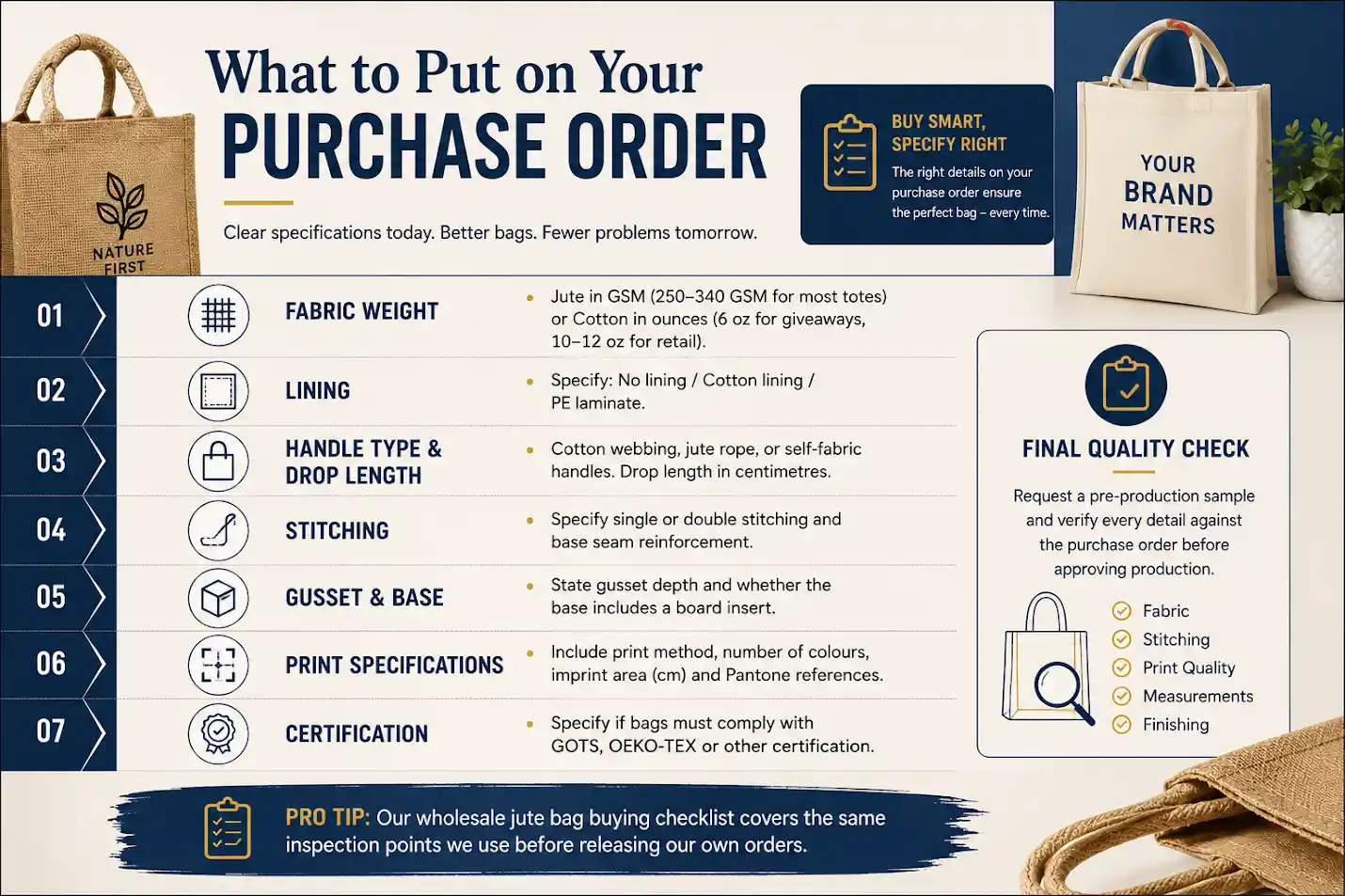
Vague specifications cause more bag order problems than manufacturing defects. A description like “jute tote, natural, one-colour print” leaves too much open to interpretation. Instead, specify the following on your purchase order:
- Fabric weight: Jute in GSM, with 250 to 340 GSM covering most tote bags, or cotton in ounces, with 6 oz for giveaways and 10 to 12 oz for retail applications.
- Lining: Specify whether the bag has no lining, a cotton lining, or a PE laminate.
- Handle type and drop length: Cotton webbing, jute rope, or self-fabric handles, with the drop length measured in centimetres.
- Stitching: Specify single or double stitching and whether the base seam includes reinforcement.
- Gusset and base: State the gusset depth and whether the base includes a board insert.
- Print specifications: Include the print method, number of colours, imprint area in centimetres, and Pantone references.
- Certification: Specify whether the bags must comply with GOTS, OEKO-TEX, or another certification requirement.
Once the specifications are final, request a pre-production sample and verify every detail against the purchase order before approving production. Our wholesale jute bag buying checklist covers the same inspection points we use before releasing our own orders.
Juco: When The Blend Is The Right Answer
Juco combines roughly 55% jute and 45% cotton into a single woven fabric. It retains the natural texture and structural strength of jute while providing a smoother printing surface that handles three- and four-colour artwork far better than pure jute.
Many buyers switch to juco after discovering that their artwork is too detailed for jute but their branding still calls for a more natural look than plain canvas provides. Juco lies somewhere in between the two in terms of price, costing more than jute but less than heavy organic cotton. Our comparison of jute, cotton, and juco for wholesale branding explores the differences in more detail.
One limitation deserves attention. As a blended fabric, juco does not qualify for GOTS certification, which requires products to contain organic fibres that meet the standard’s certification requirements. If verified organic status forms part of your brand claim, juco is not the right choice.
Choosing By Brand Type
Material choice follows the application more closely than the budget. The right bag depends on what it needs to carry, how it will be branded, and how long people are expected to use it. This is the decision matrix we use before approving the first production sample.
| Brand or Use Case | Recommended Material | Reason |
|---|---|---|
| Farmers market or organic food | Uncoated jute | Natural appearance, lower cost, simple eco branding |
| Wine, spirits, gift packaging | Jute or juco | Better shape retention and premium natural finish |
| Fashion or lifestyle tote | 10–12 oz cotton canvas | Print fidelity and full-colour graphics |
| Museum, gallery, bookshop | Cotton canvas | Fine logo reproduction and premium finish |
| Large-volume event giveaway | Jute or juco | Best unit economics at scale with a simple logo |
| Certified organic marketing claim | GOTS organic cotton | Verifiable organic fibre certification |
| Weekly grocery shopper | Cotton canvas | Washable, longest service life, highest reuse rate |
| Rustic look plus detailed artwork | Juco | Best print quality available on a jute-based fabric |
Mixed-material programmes are common in large orders. Many buyers specify cotton canvas for general attendee bags and reserve jute or juco for VIP gifts and sponsor kits. This approach controls overall procurement costs while giving high-value recipients something better to hold. Our guide on jute bags for corporate gifting explains the strategy in more detail.
The Final Thoughts
No single material suits every requirement. Jute is the better fit when natural texture matters and the artwork is simple. Cotton canvas works best when print quality, washability, or colour range takes priority. Juco offers a balance between the two, provided certified organic fibres are not part of the requirement.
Whatever material you choose, check the spec sheet as it will have a greater impact on the final result than the fabric alone. Review a production sample before approving the order and check it against your purchase specification. If you want to compare all three fabrics before production, talk to our team, and we can provide sample swatches with your artwork applied to each one.
Frequently Asked Questions
Are jute bags better for the environment than cotton bags?
Jute uses less water and fewer agrochemicals than conventional cotton, so on cultivation metrics it performs better. The gap narrows sharply against organic cotton. Reuse rate matters more than fibre choice, since a bag carried weekly for three years beats a greener bag used twice.
Can jute bags be washed?
No. Jute should be spot-cleaned with a damp cloth and dried fully in ventilated air. Machine washing distorts the weave and weakens the seams. Cotton canvas is machine washable on a gentle cycle, which is why it suits grocery and daily-use applications better.
Which is cheaper for bulk orders, jute or cotton?
Jute fabric is generally cheaper than comparable cotton canvas at matched construction. The advantage narrows once ocean freight is included, because jute weighs more per unit, and it can disappear entirely when the jute bag requires lamination.
Is a laminated jute bag still biodegradable?
No. PE linings and BOPP laminates are plastic and will not break down alongside the jute. Marketing that bag as biodegradable without qualification risks falling foul of the FTC Green Guides. Ask suppliers to confirm coating status in writing before you publish any claim.
What GSM should I specify for a jute tote?
For promotional and retail totes, 250 to 340 GSM covers most requirements. Lighter fabric suits drawstring pouches and wine bags. Constructions above 400 GSM suit sacks and heavy grocery use where load capacity beats hand feel.
Categories
Latest Post
-
-
July 31, 2026
Jute Bags Manufacturer: The Complete B2B Sourcing Guide
-
July 24, 2026
Cotton Tote Bags Wholesale: The 2026 Bulk Buyer’s Guide