
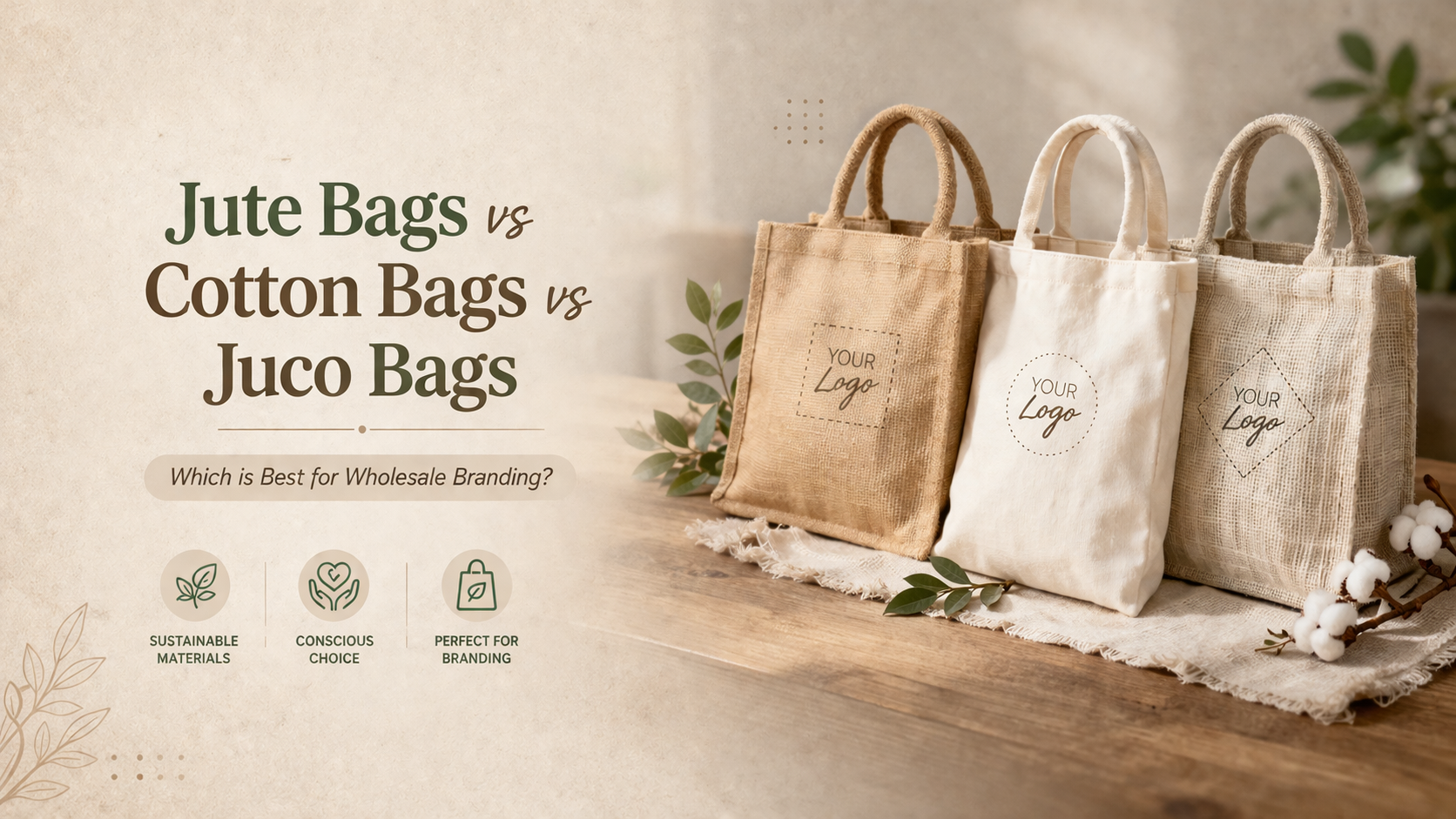
Jute Bags vs Cotton Bags vs Juco Bags: Which is Best for Wholesale Branding?
-

17th Apr, 2026
-

(0)

By : Sara International
Summary : For wholesale branding, juco bags offer the best all-round value — combining jute’s structural strength with cotton’s print-friendliness — making them ideal for premium corporate gifting and retail packaging. Jute bags win on sustainability and cost-per-unit for bulk orders above 1,000 pieces. Cotton bags are best when vibrant multi-colour printing and a soft consumer experience matter most.
Choosing the wrong bag material for your wholesale branding order can cost you more than money — it can cost you brand perception. Whether you’re a retailer sourcing 5,000 tote bags, an event organiser running a corporate gifting campaign, or an importer building an eco-friendly product line, the material you pick determines how your brand is experienced every single day.
Jute, cotton, and juco bags are the three dominant natural fibre options in the global wholesale market right now. Each has loyal advocates. Each has real trade-offs. And frankly, most comparison guides online skim the surface when it comes to what wholesale buyers actually need to know: MOQ, print quality, sustainability credentials, GSM options, and per-unit economics at scale.
This guide goes deeper. At Sara International, we manufacture and export all three material types from India — so we’re giving you the unfiltered, manufacturer-side comparison that helps you make the right call for your brand.
What Are Jute, Cotton, and Juco Bags?
Before we compare them head-to-head, let’s establish what each material actually is — because the terminology is frequently confused, especially around juco.
Jute is a long, golden vegetable fibre extracted from the Corchorus plant stem, grown predominantly in the Ganges Delta region of West Bengal, India, and Bangladesh. India produces over 75% of the world’s jute goods supply, making Indian manufacturers the most cost-competitive source globally. Jute fabric has a characteristic coarse, woven texture with a natural sheen that communicates an earthy, artisanal identity instantly.
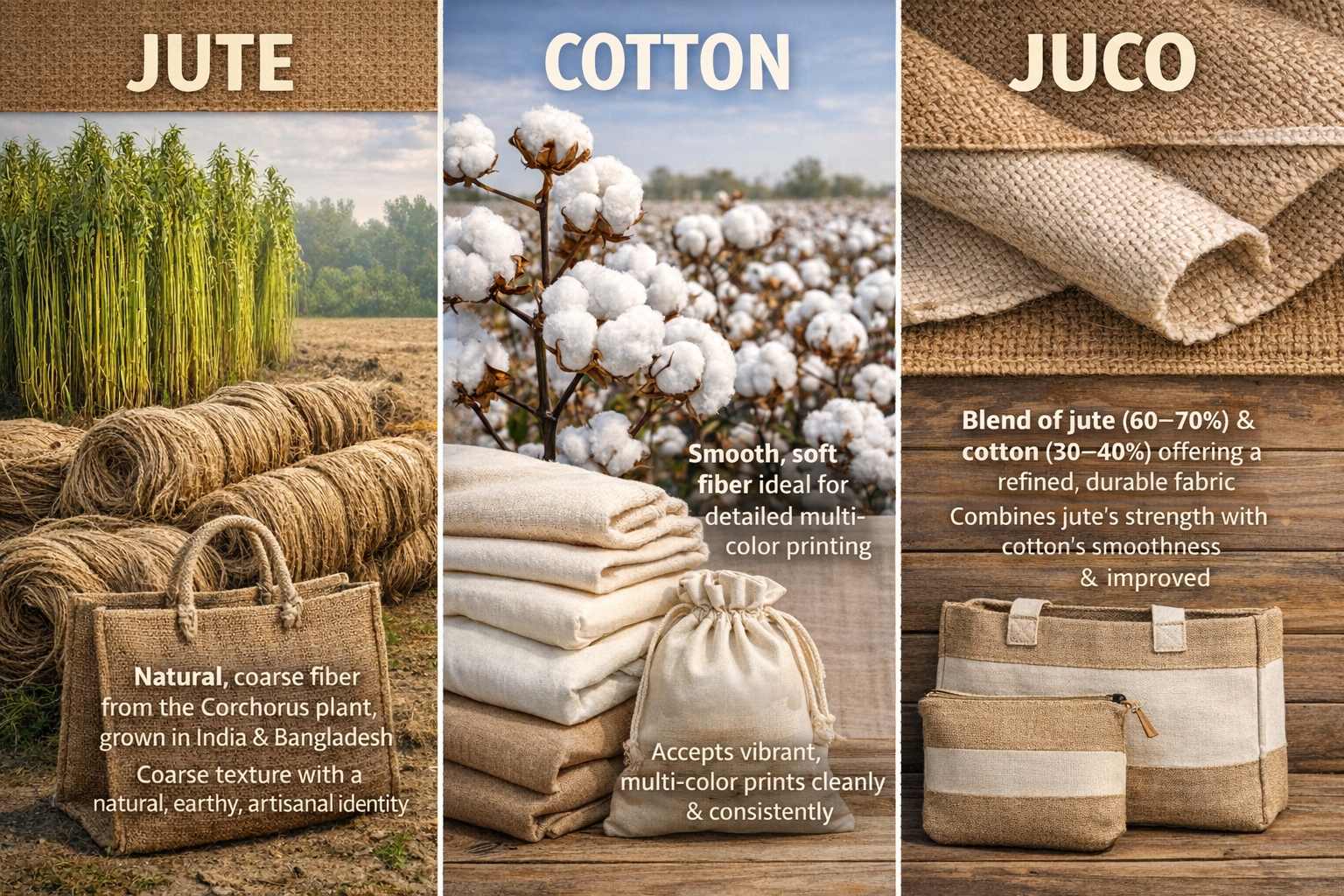
Cotton in the bag industry most commonly refers to canvas (a tightly woven, heavier cotton fabric) or standard cotton twill. It’s a smooth, soft-textured material available in a wide GSM range — from lightweight 100 GSM muslin drawstring bags all the way to heavy 400 GSM canvas totes. Cotton’s smooth surface is its single biggest advantage for branding: it accepts detailed multi-color prints cleanly and consistently.
Juco — short for Jute-Cotton — is a blended fabric where jute fibre and cotton are woven together. The standard commercial ratio is typically 60–70% jute and 30–40% cotton, though this varies by manufacturer. The cotton component softens the texture, improves dye uptake, and creates a more refined surface for logo printing, while the jute component maintains structural rigidity and load-bearing strength. You can learn more about how Sara International uses juco in specialized applications in our guide to juco laptop bags for everyday professionals.
Head-to-Head Comparison: Jute vs Cotton vs Juco Bags for Wholesale Branding
The Quick-Reference Table
| Feature | Jute Bags | Cotton Bags | Juco Bags |
|---|---|---|---|
| Texture | Coarse, rustic, woven | Smooth, soft | Semi-smooth, refined |
| GSM Range | 200–400 GSM | 100–400 GSM | 200–360 GSM |
| Print Quality | Good (bold designs only) | Excellent (multi-colour) | Very Good (detailed possible) |
| Min Font Size for Printing | 32pt minimum | 10pt+ | 18pt+ |
| Durability / Load Capacity | 10–15 kg | 6–10 kg | 8–12 kg |
| Biodegradability | 2–6 months in soil | 1–5 months in soil | 2–5 months in soil |
| Water Footprint | Very Low | High (cotton = water-intensive) | Low–Medium |
| Approx. Wholesale Unit Price* | $1.80–$4.00 | $1.50–$3.50 | $2.00–$4.50 |
| MOQ (Sara International) | 500 pieces | 500 pieces | 500 pieces |
| Washable? | Spot-clean only | Machine washable | Spot-clean preferred |
| Best Branding Style | Screen print (1–3 colours) | Screen, digital, embroidery | Screen print (2–4 colours) |
| Best Brand Personality | Rustic, earthy, artisanal | Modern, premium, lifestyle | Sophisticated, sustainable |
*Pricing indicative for 1,000+ unit orders with single-colour logo printing from India. Final pricing depends on GSM, size, handle type, and customisation level.
Jute Bags for Wholesale Branding: The Full Picture
Strengths of Jute Bags in Bulk Orders
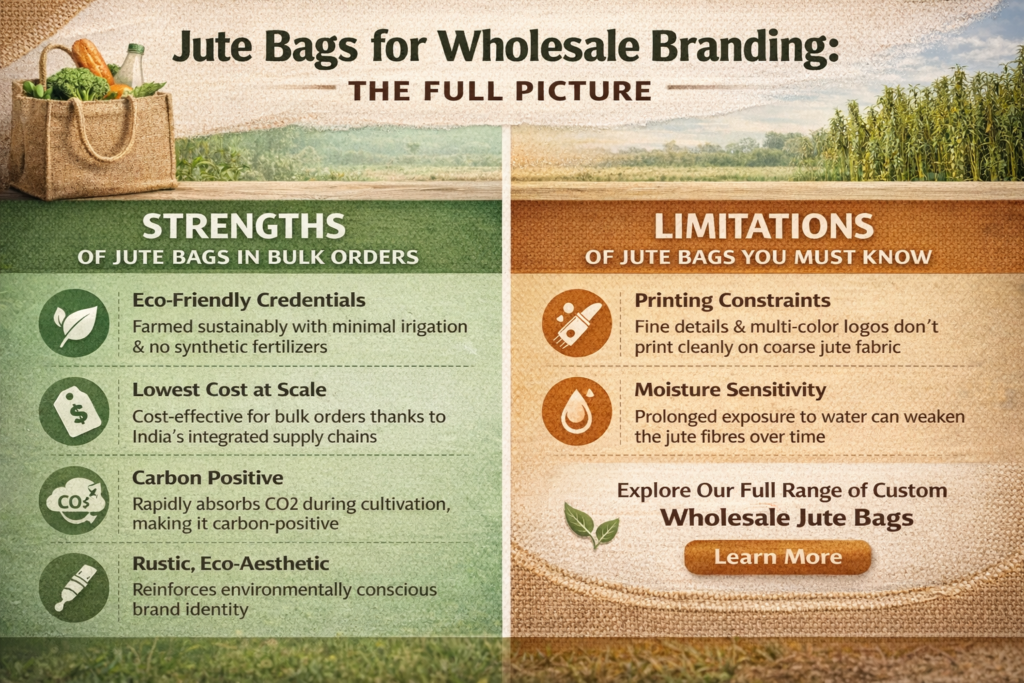
Jute is the most established eco-bag material in the wholesale market for very good reason. Its strength-to-cost ratio at scale is hard to beat. For bulk orders above 1,000 pieces, jute bags consistently deliver the lowest per-unit production cost among natural fibre options because India has deeply integrated raw material supply chains — from farm to finished bag — particularly in West Bengal and Bihar.
Jute’s environmental credentials are exceptional. It’s a rain-fed crop requiring minimal irrigation, no synthetic fertilisers, and it actively absorbs CO2 during cultivation — making it one of the few genuinely carbon-positive raw materials available in the bag industry. For brands with public sustainability commitments, jute’s story writes itself.
The rustic, woven aesthetic of jute has become a visual shorthand for authenticity and eco-consciousness. Organic food brands, farm-to-table retailers, wellness companies, and sustainable lifestyle brands consistently choose jute because the bag itself communicates their values without a word of text.
Explore Sara International’s full range of wholesale jute bags available for custom branding and bulk export orders.
Limitations of Jute Bags You Must Know Before Ordering
Jute’s coarse, uneven weave surface is a real printing constraint. Fine detail, small fonts below 32pt, and photographic multi-colour designs do not reproduce cleanly on standard jute fabric. Screen printing with 1–3 spot colours works exceptionally well. Digital printing is possible but costs more and the texture still shows through the ink. If your brand identity relies on a complex, multi-colour logo or detailed illustration, jute will disappoint.
Jute is also moisture-sensitive when heavily saturated. While it has natural moisture-wicking properties suitable for daily use, prolonged exposure to water can weaken the fibre. Laminated jute bags (with a PP or cotton lining) resolve this for grocery and market applications.
Our blog on why your grocery store needs jute bags goes deeper into jute’s practical applications for retail environments.
Cotton Bags for Wholesale Branding: The Full Picture
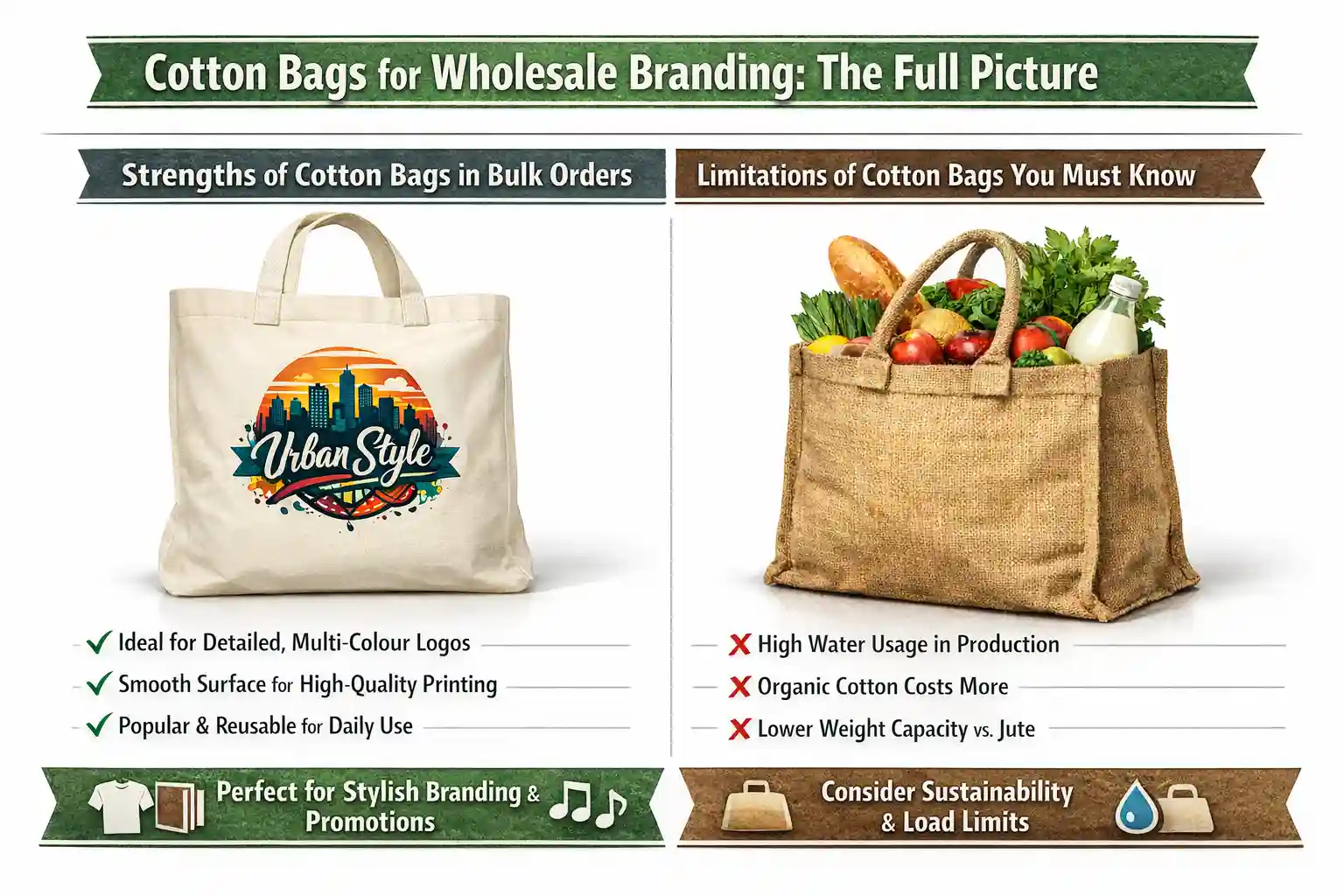
Strengths of Cotton Bags in Bulk Orders
Cotton is the universal crowd-pleaser. Its smooth surface accepts virtually any printing technique — screen printing, direct-to-garment digital printing, embroidery, heat transfer, and foil stamping — with excellent colour fidelity. If your brand has a complex logo with fine lines, gradients, or multiple pantone colours, cotton is almost always the right material choice.
Cotton totes also have a premium tactile quality that consumers respond to positively. A well-made cotton canvas bag signals quality and is significantly more likely to be kept and used daily than a promotional synthetic bag — which translates directly to brand impression frequency over time. Cotton’s machine-washable property also extends its usable lifespan considerably.
For fashion brands, event merchandise, bookstores, universities, and lifestyle retailers, cotton canvas tote bags have become a de facto branded item — expected by audiences and appreciated as genuinely useful.
Read our detailed breakdown on why wholesale cotton tote bags are the smart branding choice for modern retail brands.
Limitations of Cotton Bags You Must Know Before Ordering
Cotton’s environmental footprint is significantly larger than jute’s. Conventional cotton is one of the most water-intensive crops in agriculture — producing a single cotton tote bag can require 1,141+ litres of water. For brands with genuine sustainability commitments, this is a non-trivial consideration.
The solution is GOTS-certified organic cotton, which eliminates synthetic pesticides and organic cotton farming requires 91% less water than conventional cotton. However, organic cotton commands a price premium of 15–30% over conventional cotton bags, which can substantially impact bulk order economics.
Cotton bags at equivalent GSM also carry less weight than jute — typically 6–10 kg load capacity versus 10–15 kg for jute — meaning they’re less suitable for heavy grocery or market-use applications.
Our guide on switching to cotton bags over plastic covers the environmental trade-offs in more depth.
Juco Bags for Wholesale Branding: The Full Picture
Why Juco Is the Fastest-Growing Material in Wholesale Branding
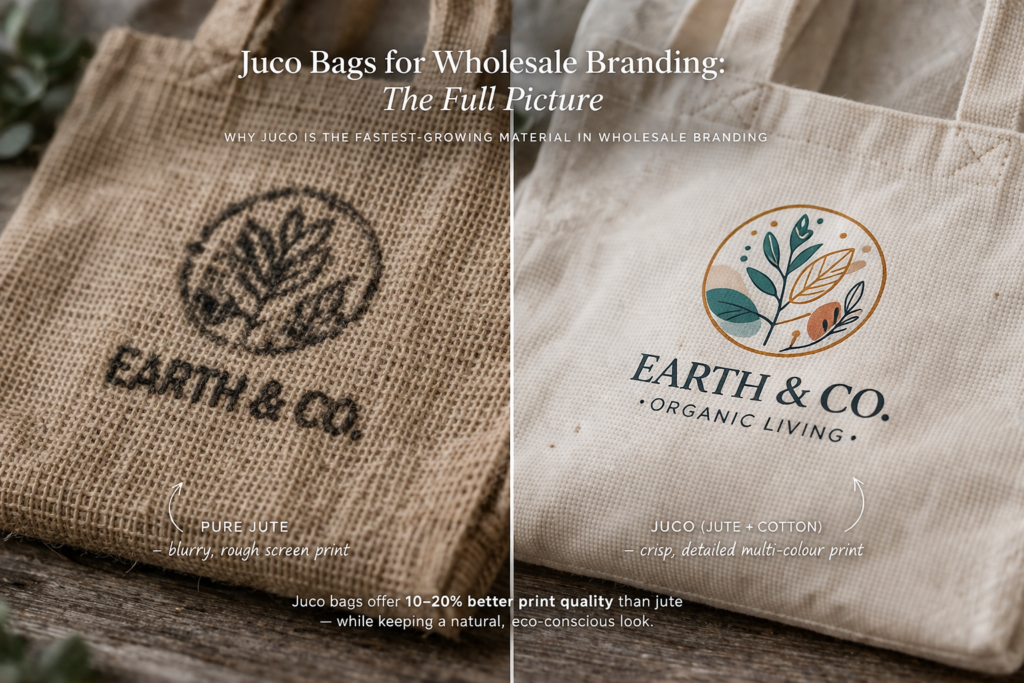
Juco bags represent the most interesting innovation in the eco-bag wholesale market over the past five years. By blending jute and cotton at the fibre level — typically 60–70% jute, 30–40% cotton — manufacturers achieve a fabric that genuinely outperforms either material alone in a branding context.
The cotton component smooths the surface enough to accept more detailed prints than pure jute. The jute component maintains structural strength and load capacity beyond what standard cotton can offer. The result is a bag that visually reads as natural and eco-conscious (essential for modern brand positioning) while functioning as a premium product (essential for gifting and retail applications).
Juco bags hit a pricing sweet spot: they typically cost 10–20% more than equivalent jute bags but deliver meaningfully better print quality and a more refined consumer experience. For corporate gifting, premium retail packaging, and branded merchandise targeting B2B buyers, juco consistently delivers better brand ROI.
Discover Sara International’s range of custom juco bags for wholesale orders, including tote, laptop, and promotional bag styles.
How the Jute-to-Cotton Ratio in Juco Affects Your Order
This is the detail most competitors don’t tell you: not all juco fabric is the same. A 70/30 jute-cotton blend will have a slightly more textured surface, stronger structure, and lower cost. A 55/45 blend will feel closer to cotton, accept finer prints, and cost slightly more. When placing a wholesale juco bag order, always ask your manufacturer for the specific fibre ratio and request a printed sample before committing to production.
At Sara International, we offer transparency on fibre ratios across all our juco products and provide pre-production print proofs as standard practice for bulk orders.
For inspiration on how juco bags perform in real use cases, read our post on how to pick a design for custom juco tote bag that works for your brand.
Which Bag Is Best for Your Brand? A Use-Case Decision Framework
If your brand is in organic food, farmers markets, or wellness: Choose jute. The rustic texture is brand-aligned and the environmental story is unmatched. Screen print your logo in 1–2 colours for maximum impact.
If your brand is in fashion, lifestyle, events, or retail: Choose cotton canvas. The smooth surface enables the print quality your brand identity demands. Go organic cotton if sustainability is a brand pillar.
If your brand is in corporate gifting, premium packaging, or B2B: Choose juco. The premium look, improved print quality, and balanced eco-credentials make it the ideal choice for professional branding. Our guide on jute bags for corporate gifting explores how natural fibre bags are transforming corporate gifting strategy — and juco represents the next evolution of that trend.
If you’re running a large-scale promotional campaign (5,000+ units): Choose jute for best cost-per-unit economics, or juco if print quality matters more than per-unit cost.
If you’re importing to the US, EU, or Australia: All three materials are export-ready from India. Jute and juco bags from Indian manufacturers typically carry OEKO-TEX and GRS certifications. GOTS-certified cotton bags are also available. Sara International exports to multiple markets — read our detailed guide on importing organic jute bags from India to the USA for regulatory and logistics guidance.
Sustainability Scorecard: Jute vs Cotton vs Juco
Sustainability is no longer a differentiator in wholesale branding — it’s a baseline expectation. But not all “eco-friendly” bags carry equal environmental credentials. Here’s an honest comparison:
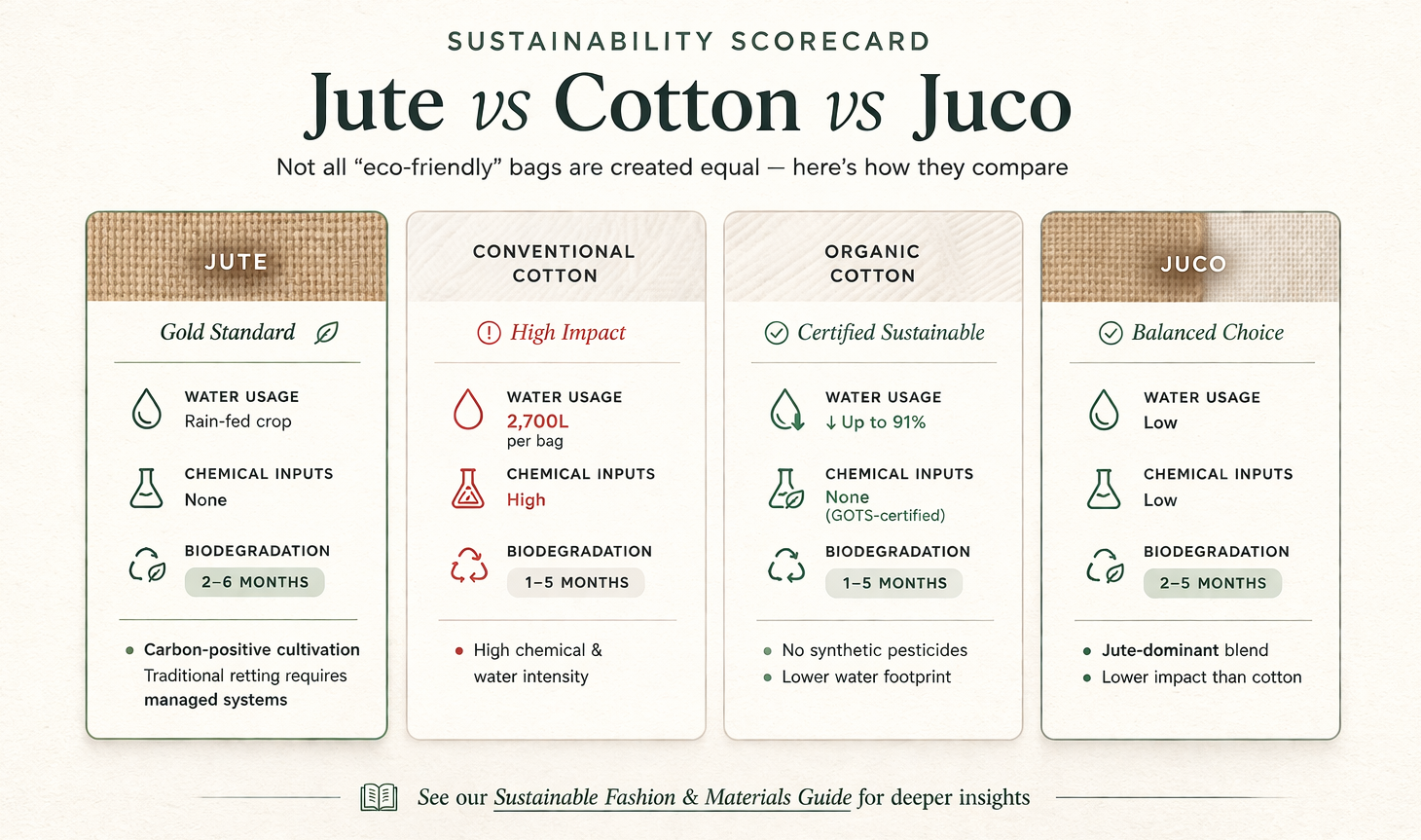
Jute: The gold standard for low environmental impact. Rain-fed crop, no synthetic inputs, biodegrades in 2–6 months, carbon-positive during cultivation. The only downside: processing jute fibre traditionally uses retting (water soaking) which can impact local waterways if not managed properly. Reputable Indian manufacturers use managed, closed-loop retting systems.
Conventional Cotton: High environmental cost. Accounts for 2.5% of global agricultural land but consumes approximately 10% of all agricultural chemicals. A single cotton bag requires an estimated 2,700 litres of water to produce. Biodegrades in 1–5 months — environmental impact is in the growing, not the disposal.
Organic Cotton: Significantly better. Eliminates synthetic pesticides, reduces water usage by up to 91%, and is often GOTS-certified. Higher cost, but justifiable for brands where environmental claims must stand scrutiny.
Juco: Inherits jute’s low-input cultivation profile for the majority of its fibre content, with cotton adding only a minority fraction. Net environmental profile is closer to jute than to cotton. Biodegrades in 2–5 months.
Our guide on sustainable fashion with jute-cotton materials provides further reading on the environmental credentials of natural fibre bags.
Wholesale Pricing Guide: What to Expect at Scale
Pricing for wholesale branded bags depends on GSM, bag dimensions, handle type, number of print colours, and order volume. Here’s a realistic framework for planning wholesale budgets:
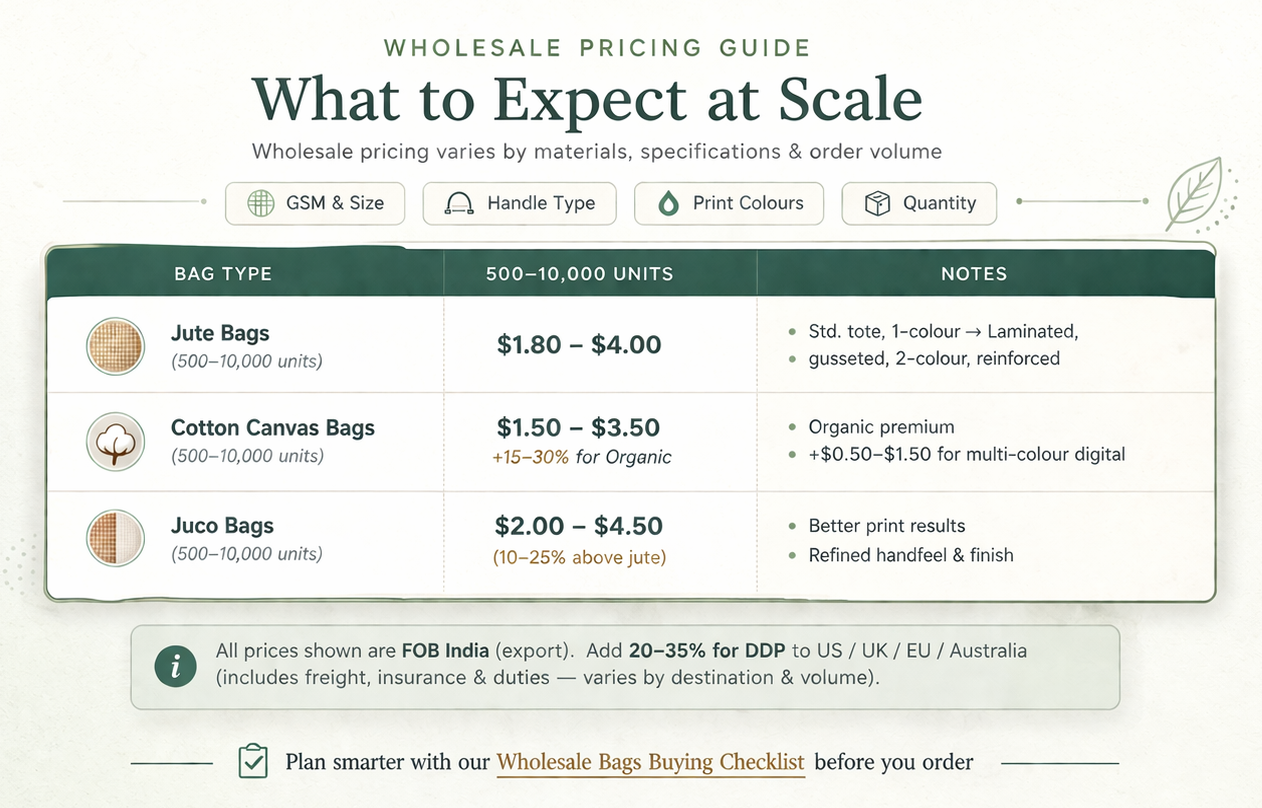
Jute Bags (500–10,000 unit range): $1.80–$4.00 per unit. Lower end for standard tote with single-colour screen print. Upper end for laminated, gusseted grocery bag with two-colour print and reinforced handles.
Cotton Canvas Bags (500–10,000 unit range): $1.50–$3.50 per unit for standard canvas tote. Organic cotton adds 15–30% premium. Multi-colour digital printing adds $0.50–$1.50 per unit.
Juco Bags (500–10,000 unit range): $2.00–$4.50 per unit. The blend premium over standard jute is typically 10–25%, offset by better print results and a more refined consumer experience.
All pricing above is indicative for FOB India export pricing. DDP pricing to US, UK, Europe, or Australia adds freight, insurance, and import duties — typically 20–35% additional cost depending on destination and order volume.
Use our wholesale bags buying checklist to structure your supplier evaluation and avoid common bulk-order pitfalls.
How Corporate Branding Is Shifting Toward Natural Fibre Bags
The corporate gifting and promotional products industry is undergoing a structural shift. Plastic and synthetic bag giveaways are facing regulatory headwinds across major markets — California, New York, Oregon, and the EU have all moved to restrict single-use plastics — while consumer expectations for brand environmental accountability have never been higher.
Natural fibre bags — jute, cotton, and juco — are the beneficiaries of this shift. According to Future Market Insights, the global jute bag market was valued at USD 0.9 billion in 2025 and is forecast to reach USD 1.1 billion by 2035. The growth is driven by both regulatory pressure and genuine consumer preference.
For brands considering the transition, our editorial on how corporate gifting is moving toward eco-friendly tote bags is essential context.
Why Source Wholesale Jute, Cotton, or Juco Bags from India?
India is the world’s largest producer of raw jute, accounting for over 60% of global output. West Bengal — where Sara International operates — is the epicentre of India’s jute industry, with vertically integrated supply chains from raw fibre cultivation through to finished, branded bag export. This vertical integration delivers two structural advantages: price competitiveness and quality control.
Indian bag manufacturers catering to the wholesale export market routinely hold multiple international certifications: GOTS (Global Organic Textile Standard) for organic cotton, OEKO-TEX Standard 100 for chemical safety, GRS (Global Recycled Standard), and ISO 14001 for environmental management systems. These certifications are critical for importers selling into regulated markets in the US, EU, and Australia.
Ready to Source Certified Jute, Cotton & Juco Bags from India?
Contact Sara International for a custom quote and samples from West Bengal’s jute heartland.
The Bottom Line: Which Wholesale Bag Is Right for Your Brand?
There’s no single “best” material — the right choice depends on what your brand needs to communicate, what your print requirements are, and how your budget is structured.
If sustainability credentials and bulk cost-efficiency are your priorities, jute bags are your strongest choice. If premium print quality and consumer experience come first, cotton canvas bags deliver. If you want the best balance of all factors — eco story, structural quality, and brand-ready printability — juco bags are the wholesale sweet spot that growing numbers of global brands are discovering.
At Sara International, we help brands navigate this decision every day. We manufacture and export all three material types from our facility in India, with full customisation, transparent pricing, and export certifications for all major markets.
Ready to get a wholesale quote for your branded bag order? Contact Sara International with your brief — material, quantity, dimensions, and print requirements — and we’ll provide a detailed quote and sample option within 48 hours.
FAQs
Q. What is the minimum order quantity (MOQ) for wholesale jute, cotton, or juco bags?
At Sara International, the standard MOQ is 500 pieces per design for all three material types — jute, cotton, and juco. Lower MOQs may be available for sampling (50–100 pieces). Large-scale export orders above 5,000 pieces attract tiered pricing discounts.
Q. Which bag material gives the best print quality for a complex logo?
Cotton canvas offers the best print surface for detailed, multi-colour logos — it accepts fine lines, small text (10pt+), and full-colour digital printing cleanly. Juco is the second-best option, suitable for 2–4 colour designs. Jute requires bold, simple designs with a minimum 32pt font size for reliable reproduction.
Q. Are juco bags more expensive than jute bags wholesale?
Yes, juco bags typically cost 10–25% more than equivalent jute bags at the same order volume, due to the cotton component in the blend. However, the improvement in print quality and consumer experience often delivers better brand ROI, particularly for premium gifting or retail applications.
Q: What’s the difference between laminated and unlaminated jute bags?
Laminated jute bags have a PP (polypropylene) or cotton interior lining that adds moisture resistance, structural rigidity, and a cleaner interior surface. They’re ideal for grocery, food, or liquid product applications. Unlaminated jute bags are lighter, more breathable, and fully biodegradable — better for promotional or gifting use.
Q: How long do jute, cotton, and juco bags take to biodegrade?
In soil conditions, jute bags biodegrade in approximately 2–6 months, cotton bags in 1–5 months, and juco bags in 2–5 months. All three are fully biodegradable natural fibres. Compare this to synthetic bags (polypropylene non-woven) which can persist for 20–30 years.
Q: Can I get GOTS-certified organic cotton bags in wholesale quantities from India?
Yes. GOTS-certified organic cotton bags are available from certified Indian manufacturers, including Sara International. GOTS certification verifies both the organic status of the fibre and the ethical standards of the manufacturing process — critical for brands making organic or sustainability claims to consumers.
Q: Which bag is best for corporate gifting at a large event?
Juco bags are the most popular choice for corporate gifting due to their premium look, improved print quality over standard jute, and strong eco-credentials. For events with very large attendee numbers where per-unit cost is paramount, laminated jute bags with single-colour screen printing offer excellent value. Read our detailed guide on jute bags for corporate gifting for use-case specific advice.
Q: What printing techniques work on jute, cotton, and juco bags?
Screen printing (1–4 colours) works on all three materials and is the most cost-effective for bulk orders. Digital printing works best on cotton and is possible on juco, but the texture of jute limits digital print quality. Embroidery is available on all three and is preferred for premium corporate gifting applications.
Categories
Latest Post
-

-
July 31, 2026
Jute Bags Manufacturer: The Complete B2B Sourcing Guide
-
July 24, 2026
Cotton Tote Bags Wholesale: The 2026 Bulk Buyer’s Guide

What is the minimum order quantity (MOQ) for wholesale jute, cotton, or juco bags?
Are juco bags more expensive than jute bags wholesale?
What’s the difference between laminated and unlaminated jute bags?
How long do jute, cotton, and juco bags take to biodegrade?
Can I get GOTS-certified organic cotton bags in wholesale quantities from India?
Which bag is best for corporate gifting at a large event?
What printing techniques work on jute, cotton, and juco bags?
Which bag material gives the best print quality for a complex logo?
