

Jute Bags Manufacturer: The Complete B2B Sourcing Guide
-

31st Jul, 2026
-
(0)


By : Sara International
Choosing a jute bags manufacturer is not just a shopping decision. It is a business risk decision. India alone exported US$229 million worth of jute goods in FY25, up from US$204 million the year before, with the United States taking close to 24% of those exports (IBEF, citing DGCIS data). The market has plenty of suppliers. The real challenge is separating a genuine factory from a trading company with a polished website.
A buyer orders 320 GSM and receives 240 GSM. Handles pull out on the third grocery run. A shipment sits at the port because the fibre-content label is missing. These problems are more common than many buyers expect, and most of them can be prevented during the RFQ stage.
This guide covers the complete decision-making process, from material properties and manufacturing methods to GSM selection, certifications, supplier evaluation, pricing, and the customs requirements for export.
How to Choose a Jute Bags Manufacturer
Every supplier promises quality, competitive pricing, and on-time delivery. The real difference becomes clear when you ask for technical details, production records, and supporting documents. A reliable manufacturer answers these questions with evidence, not sales claims.
Use the checklist below before placing an order. A supplier who meets these requirements is far more likely to deliver consistent quality and avoid production or compliance issues.
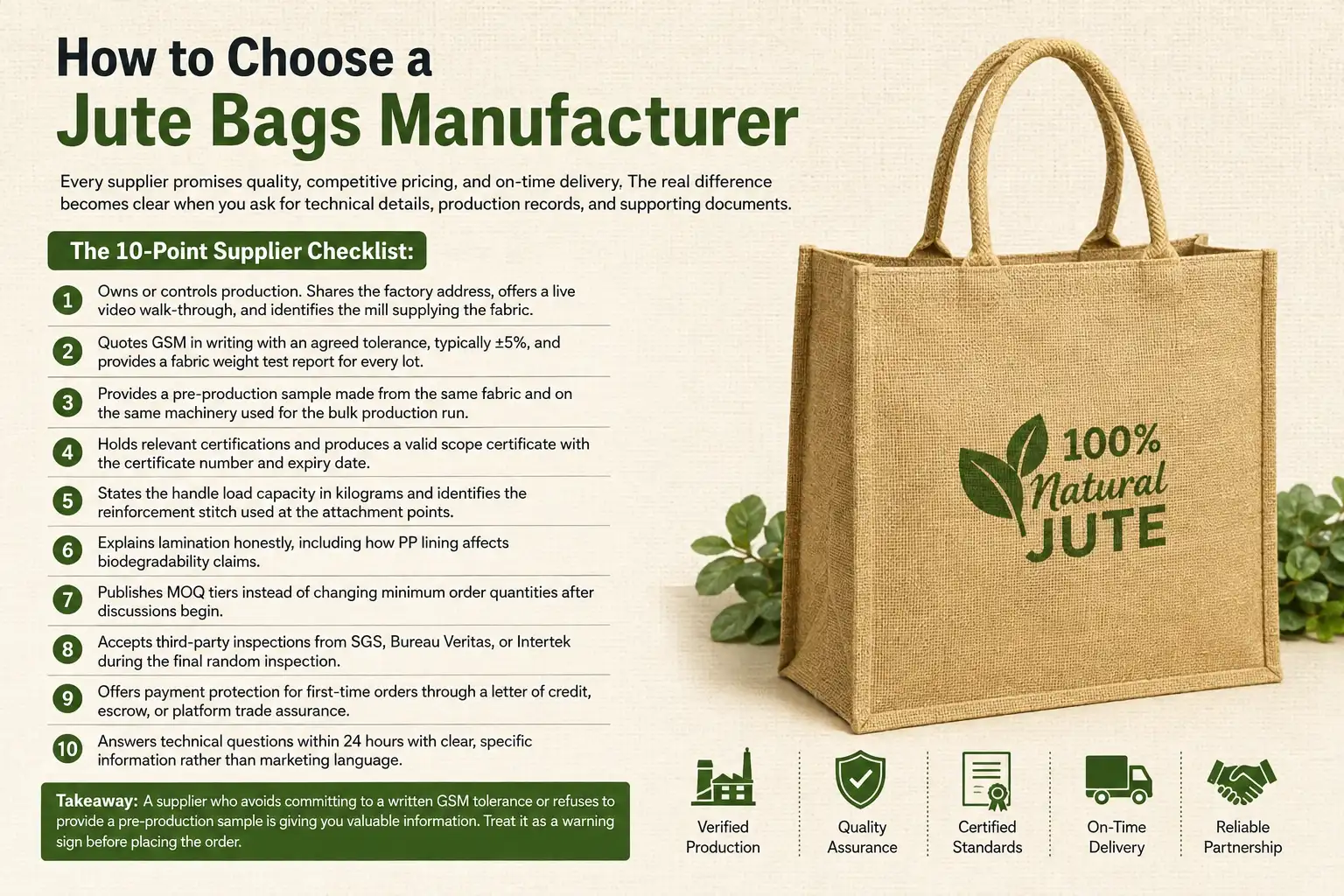
The 10-Point Supplier Checklist :
- Owns or controls production. Shares the factory address, offers a live video walk-through, and identifies the mill supplying the fabric.
- Quotes GSM in writing with an agreed tolerance, typically ±5%, and provides a fabric weight test report for every lot.
- Provides a pre-production sample made from the same fabric and on the same machinery used for the bulk production run.
- Holds relevant certifications and produces a valid scope certificate with the certificate number and expiry date.
- States the handle load capacity in kilograms and identifies the reinforcement stitch used at the attachment points.
- Explains lamination honestly, including how PP lining affects biodegradability claims.
- Publishes MOQ tiers instead of changing minimum order quantities after discussions begin.
- Accepts third-party inspections from SGS, Bureau Veritas, or Intertek during the final random inspection.
- Offers payment protection for first-time orders through a letter of credit, escrow, or platform trade assurance.
- Answers technical questions within 24 hours with clear, specific information rather than marketing language.
Takeaway: A supplier who avoids committing to a written GSM tolerance or refuses to provide a pre-production sample is giving you valuable information. Treat it as a warning sign before placing the order.
Understanding Jute as a Material
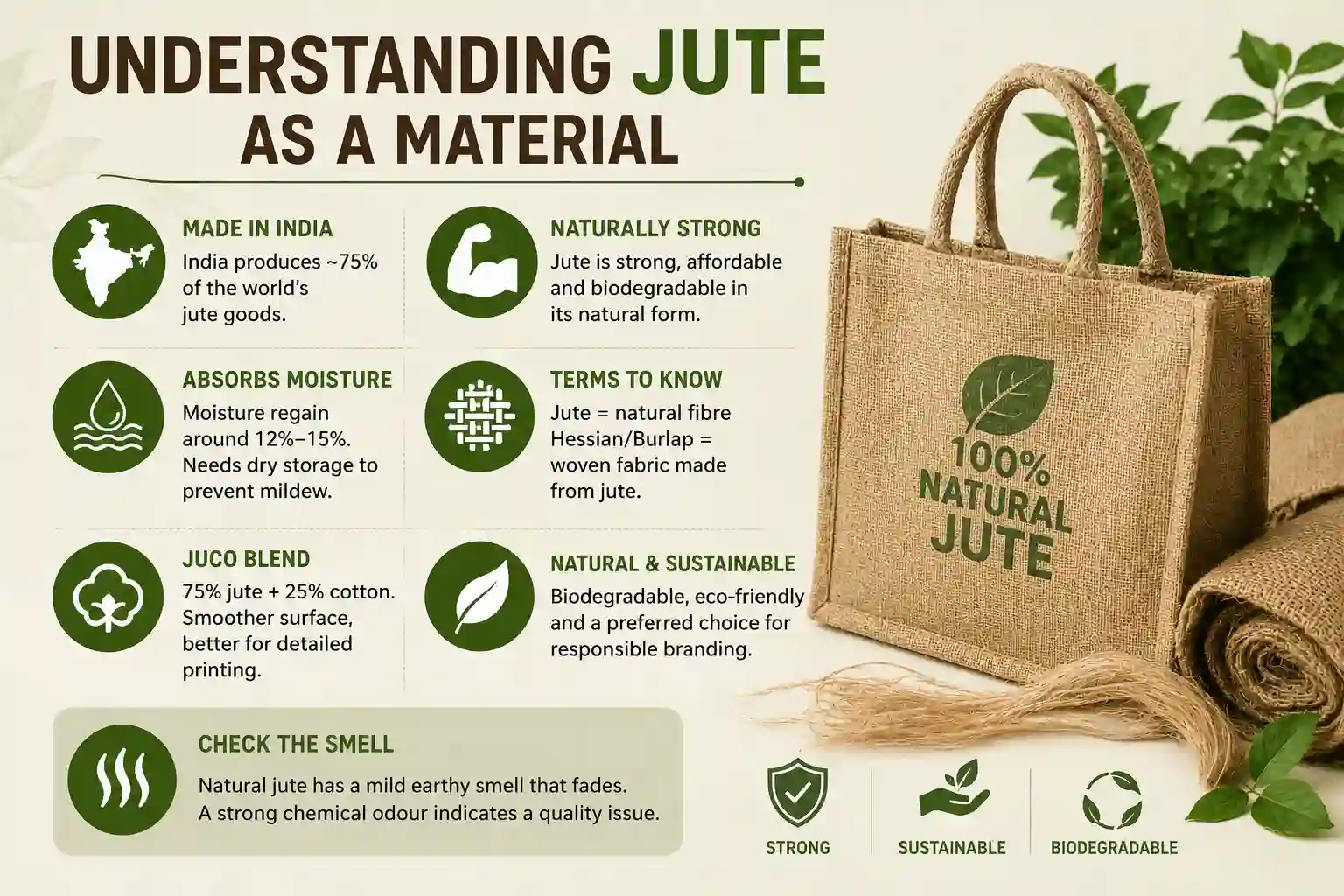
Before comparing manufacturers or bag specifications, let us understand the material itself. Jute is a bast fibre extracted from the stem of the Corchorus plant and is cultivated primarily across the Ganges delta. India produces roughly 75% of the world’s jute goods, which is why Kolkata remains the centre of most large-scale sourcing and manufacturing discussions.
Jute owes its popularity to a combination of strength, affordability, and biodegradability in its untreated form. At the same time, it naturally absorbs moisture, with a moisture regain of around 12% to 15%. If stored in damp conditions for long periods, the fibre becomes vulnerable to mildew. These material characteristics influence everything from fabric selection and storage to packaging and export handling.
The terminology can also confuse first-time buyers. Jute refers to the natural fibre itself, while burlap and hessian describe the woven fabric made from that fibre. The term hessian is more common in the UK and India, whereas burlap is widely used in North America.
Juco is a blended fabric, usually made with 75% jute and 25% cotton, that offers a smoother surface for printing and a softer finish. If your design includes fine text or intricate artwork, juco generally reproduces those details more clearly than raw hessian.
Our comparison of jute, cotton, and juco for wholesale branding explores these differences in greater detail.
One final point deserves attention before product descriptions or marketing copy go live. Natural jute has a mild earthy smell that fades within a few weeks. A strong petroleum or solvent odour, however, indicates a manufacturing or storage problem rather than a natural property of the fibre, and buyers should treat it as a quality defect.
How Jute Bags Are Manufactured
Quality issues can emerge at every stage of production. Knowing where they originate allows buyers to focus their inspections on the areas that matter most.
| Stage | What happens | Failure mode to watch |
|---|---|---|
| Retting and extraction | Stalks submerged so microbial action loosens fibre from stem. | Under-retting leaves impurities; over-retting weakens fibre outright. |
| Spinning | Fibre softened, carded, drawn and spun to a target yarn count. | Uneven yarn causes slubs, thin patches and patchy print pickup. |
| Weaving | Plain weave for most bags, twill for structured designs. | Ends and picks per inch below specification, which is how GSM gets shorted. |
| Lamination and finishing | Interior PP lining for stiffness and moisture resistance. | Bubbling, peeling, and a biodegradability claim you can no longer make. |
| Cutting | Panels, gussets, and handles cut to the approved pattern. | Small dimensional variations compound into inconsistent print placement across a production run. |
| Sewing | Bound top edges, overlocked seams, reinforced handle joints. | Handle attachment. This is where field failures start. |
| Printing | Screen printing for most work, 1 to 4 spot colours. | Minimum line weight around 1.5 pt. Gradients and photos will not hold. |
Ask your supplier which stages of production they handle in-house. A manufacturer that only cuts and sews the fabric works as a converter, with product quality largely depending on a mill outside its control. We explain every production stage and quality inspection on our manufacturing process page, while our custom logo jute bags guide covers artwork preparation and printing requirements.
Choosing the Right Jute Bag Weight (GSM)
GSM, or grams per square metre, indicates the weight of the jute fabric used to make the bag. It is also one of the most commonly misrepresented specifications, as a difference of 60 GSM is difficult to detect by touch but becomes evident when the bag starts failing in actual use.
| GSM tier | Character | Best applications | Cost and freight effect |
|---|---|---|---|
| 150 to 200 | Light, folds flat | Gift pouches, drawstring bags, cosmetics, coffee, soap | Lowest unit cost, minimal freight weight |
| 220 to 280 | Balanced, flexible | Apparel retail bags, conference and event totes | Baseline for most promotional programmes |
| 280 to 350 | Structured, stands upright | Grocery totes, wine carriers, retail reusables | Roughly 8% to 12% more fabric cost than 260 GSM, plus about 15% shipped weight |
| 350 to 400+ | Rigid, heavy duty | Bulk hauling, large beach bags, agricultural sacks | Highest cost, meaningful container weight impact at volume |
Start with three questions. What is the highest load the bag will carry, not the average? A tote carrying 10 kg of tinned goods requires 300 GSM or above with cross-stitched handles. Should the bag stand upright on a shelf? That generally calls for 280 GSM or more. Then calculate what the extra weight will add to freight costs over 50,000 units.
Editor’s note: Verify before publishing: the cost and freight percentages above and the lead-time figures in Section 6 are internal Sara Exim benchmarks. Confirm the latest figures with the operations team before going live.
Takeaway: State the GSM, tolerance, and lot-level test report in the purchase order. A verbal GSM commitment is not a specification.
Certifications and Ethical Sourcing
Certification is where buyers get sold vocabulary instead of proof. Every certificate is issued to a named legal entity, covers a defined scope, and remains valid only until its expiry date. Always ask for the scope certificate PDF and verify these details in the standard body’s public database.
| Standard | What it covers | Relevance to jute bags |
|---|---|---|
| GOTS | Organic fibre content, processing chemistry, social criteria, and chain of custody. | Applies to the cotton used in juco bags and cotton handles, not to jute itself. |
| GRS | Recycled content, along with social, environmental, and chemical requirements. | Requires a minimum of 20% recycled content for certification and 50% for a consumer-facing recycled content claim (Textile Exchange). |
| RCS | Recycled content and chain of custody only. | An entry-level recycled content standard. It does not support product-level sustainability claims. |
| OEKO-TEX 100 | Testing for harmful substances in the finished product. | Relevant for bags intended to come into contact with food, skin, or children’s products. |
| SA8000 | Working hours, wages, child labour, and workplace safety. | Increasingly requested by retail buyers in the EU and UK. |
| ISO 9001 | Quality management system. | Indicates disciplined quality management processes but does not address sustainability. |
Before you evaluate sustainability claims, remember one important fact: “organic jute” is not a recognised certification. Although jute is typically grown with minimal pesticide input, that does not qualify it as certified organic. You can read more about our approach on our sustainability page.
How to Vet a Supplier, and What It Should Cost
Most top-ranking pages for this keyword skip this part, even though it is one of the most important decisions a buyer has to make.
Red flags in the first exchange
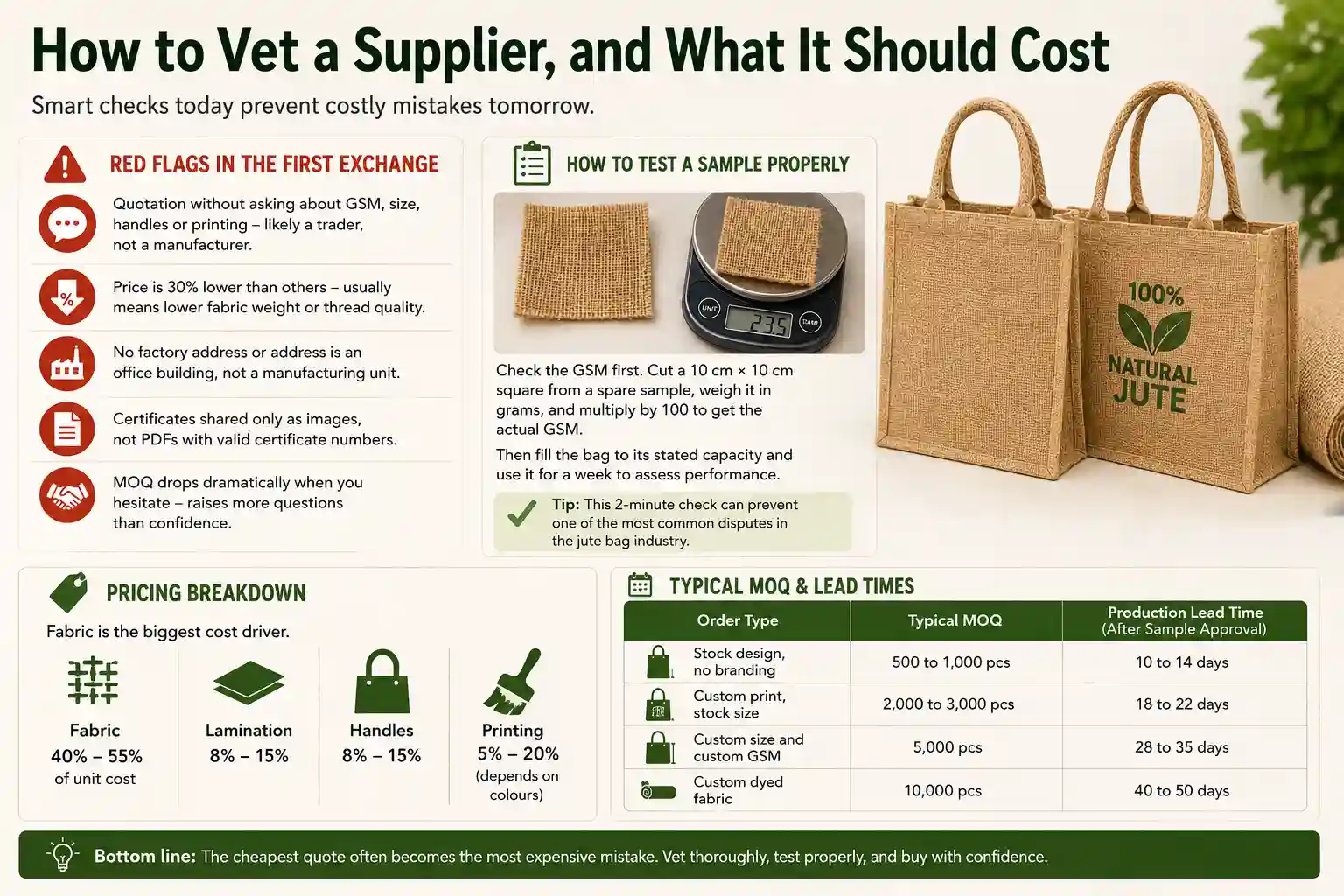
- A supplier sends a quotation without asking about your GSM, bag dimensions, handle type, or printing colours. That’s a trader pricing from a catalogue rather than a manufacturer evaluating your requirements.
- The quoted price comes in 30% lower than every other supplier. In most cases, something has been substituted, usually the fabric weight or thread quality.
- The supplier cannot provide a factory address, or the address points to an office building instead of a manufacturing facility.
- The supplier shares certificates only as image files instead of PDFs with valid certificate numbers.
- The MOQ drops dramatically the moment you hesitate. That kind of flexibility often raises more questions than confidence.
How to test a sample properly
Check the GSM first. Cut a 10 cm × 10 cm square from a spare sample, weigh it in grams, and multiply the result by 100 to calculate the actual GSM. It takes only a couple of minutes and helps resolve one of the most common disputes in the jute bag industry before production begins. Then fill the bag to its stated capacity and use it for a week to assess its overall performance.
Pricing, MOQ and lead times
Fabric contributes 40% to 55% of the unit cost, making bag size and GSM the biggest pricing factors. Lamination increases the cost by 8% to 15%, handles add another 8% to 15%, and printing contributes 5% to 20%, depending on the number of colours.
| Order type | Typical MOQ | Production lead time after sample approval |
|---|---|---|
| Stock design, no branding | 500 to 1,000 pcs | 10 to 14 days |
| Custom print, stock size | 2,000 to 3,000 pcs | 18 to 22 days |
| Custom size and custom GSM | 5,000 pcs | 28 to 35 days |
| Custom dyed fabric | 10,000 pcs | 40 to 50 days |
Sea freight from India usually takes 30 to 38 days to the US East Coast, 22 to 30 days to major EU ports, and 18 to 25 days to Australia. Pre-production samples generally cost US$30 to US$60, including courier charges, and suppliers usually adjust this amount against the final bulk order.
If your order volume falls below the supplier’s minimum requirement, choose stock fabric with a custom print instead of requesting custom fabric. We explain the cost implications in detail in our guide on minimum order quantity for custom printed eco bags.
Add sea freight: roughly 30 to 38 days from India to the US East Coast, 22 to 30 days to EU main ports, 18 to 25 days to Australia. Pre-production samples typically cost US$ 30 to US$ 60 including courier, usually credited against the bulk order. If your volumes sit below these floors, use stock fabric with custom print rather than custom fabric. We break the maths down in our note on minimum order quantity for custom printed eco bags.
For first orders under US$15,000, a 30% telegraphic transfer deposit, with the balance paid against a bill of lading copy, is the usual payment arrangement. Once the order value increases, a letter of credit at sight becomes the safer choice. Never pay 100% in advance before you’ve approved supplier samples. Print our wholesale jute bag buying checklist and keep it handy during supplier discussions.
Takeaway: Ask for FOB pricing with freight listed as a separate line item. Bundled CIF quotes can make it difficult to see the supplier’s actual margin.
Common Buyer Mistakes and Import Compliance
Six issues account for most buyer complaints in this category. Chemical odour on arrival usually indicates poor curing or the use of low-grade batching oil. Weave density falls below specification because of GSM substitution. Fibre shedding onto the contents can be prevented with lamination or a cotton lining. Folding laminated bags during shipping can crack the coating along the crease. Sustainability claims fail when they do not match the bill of materials. Moisture inside the container can also lead to mildew.
Five of these six issues can be prevented at the RFQ stage without any additional cost. They become expensive only after production begins.
| Market | Labelling | Other requirements |
|---|---|---|
| United States | Fibre content, country of origin and company name or RN under the Textile Fiber Products Identification Act (FTC). Origin must appear on the front of the label. |
APHIS may require treatment or documentation on plant-derived goods (USDA). |
| European Union | Fibre composition naming under Regulation (EU) No 1007/2011, in the language of the market. |
REACH restricts azo dyes releasing certain aromatic amines. Green claims are actively enforced. |
| Canada | Bilingual English and French, dealer identity or CA number. | CFIA rules apply where packaging contacts food. |
| Australia | Country of origin under ACCC rules. | Biosecurity is strict on plant fibre. Fumigation certificates are commonly required. |
Agree on who will provide the fumigation certificate and the fibre content label at the PO stage, not after the shipment reaches the port. If you are importing into the US, our walkthrough on importing jute bags from India to the USA lists the required documentation in the order you will need it.
Jute vs Other Alternative Materials
A good manufacturer also knows when not to recommend jute.
| Material | Strengths | Weaknesses | Relative cost |
|---|---|---|---|
| Jute / hessian | Strong, cheap, natural look, biodegradable untreated. | Coarse print surface, absorbs moisture, sheds fibre. | Baseline |
| Cotton canvas | Soft hand, fine print detail, washable. | Water-intensive crop, higher cost, less structural rigidity. | +150% to +200% |
| Juco | Retains the look of jute with a smoother printing surface. | More expensive than jute, less durable than canvas. | +25% to +50% |
| Non-woven PP | Very cheap, light, vivid colour. | Plastic material, shorter lifespan, banned in some markets. | -40% to -60% |
| Recycled PET | Water resistant, foldable, supports recycled-content claims. | Synthetic material, concerns over microfibre shedding. | +20% to +60% |
Jute is not the right material for products exposed to continuous moisture, designs that require photographic-quality printing, premium applications where a soft texture matters more than a natural finish, or bags that need regular machine washing. For a detailed comparison of the retail split, read our guide on jute bags vs. canvas tote bags.
Why Brands Choose Us
Sara Exim manufactures jute, juco and cotton bags in India for retail chains, promotional distributors and importers across the US, Europe and Australia. We quote GSM with a written tolerance, provide pre-production samples on production fabric, and welcome third-party inspection.
If you have a spec, send it and we will quote it. If not, start with the checklist in section 1, then browse our jute bag range and juco bag range to narrow the construction. Send us your specification and we will return an itemised FOB quote, lead time and sample timeline.
Frequently Asked Questions
Categories
Latest Post
-
-
July 31, 2026
Jute Bags Manufacturer: The Complete B2B Sourcing Guide
-
July 24, 2026
Cotton Tote Bags Wholesale: The 2026 Bulk Buyer’s Guide

What is a good GSM for a jute bag?
How much does a custom jute bag cost?
What is the minimum order quantity for custom jute bags?
Are jute bags biodegradable?
How do I verify the GSM my supplier actually shipped?
Should I buy FOB or CIF?
