
Cotton Bag Manufacturer and Wholesale Supplier Guide for US Buyers
-

14th Aug, 2026
-

(0)

By : Sara International
Choosing a cotton bag manufacturer is a customs decision as much as a purchasing one. A cotton tote entering the United States classifies under HTS 4202.92.15.00 and pays a 6.3% general duty, while the identical bag in man-made fiber pays 17.6% under the USITC Harmonized Tariff Schedule.
Cotton is also the fiber US Customs examines hardest. CBP enforces a rebuttable presumption under the Uyghur Forced Labor Prevention Act that goods produced wholly or in part in Xinjiang are barred from entry.
Raw material cost is rising too. USDA projects the 2026/27 US upland cotton farm price at 73 cents per pound against 62.5 cents in 2025/26, a 17% increase, in its July 2026 Cotton and Wool Outlook. Buyers importing from India and South Asia will see that in Q4 quotes.
Fiber choice moves your duty rate. Origin moves your admissibility. Lint prices move your next quote. Everything below follows from those three levers.
What A Cotton Bag Manufacturer Is, And How It Differs From A Wholesale Supplier
A cotton bag manufacturer owns cutting, sewing and finishing equipment and converts fabric rolls into finished bags. A wholesale supplier buys finished bags and resells them, usually adding decoration and warehousing.
The distinction matters for one reason: control over specification. A factory can change fabric weight, handle webbing width, gusset depth and stitch type on your order. A reseller can only sell you what already exists on its shelf.
Four supplier types serve the US market, and they suit different order profiles.
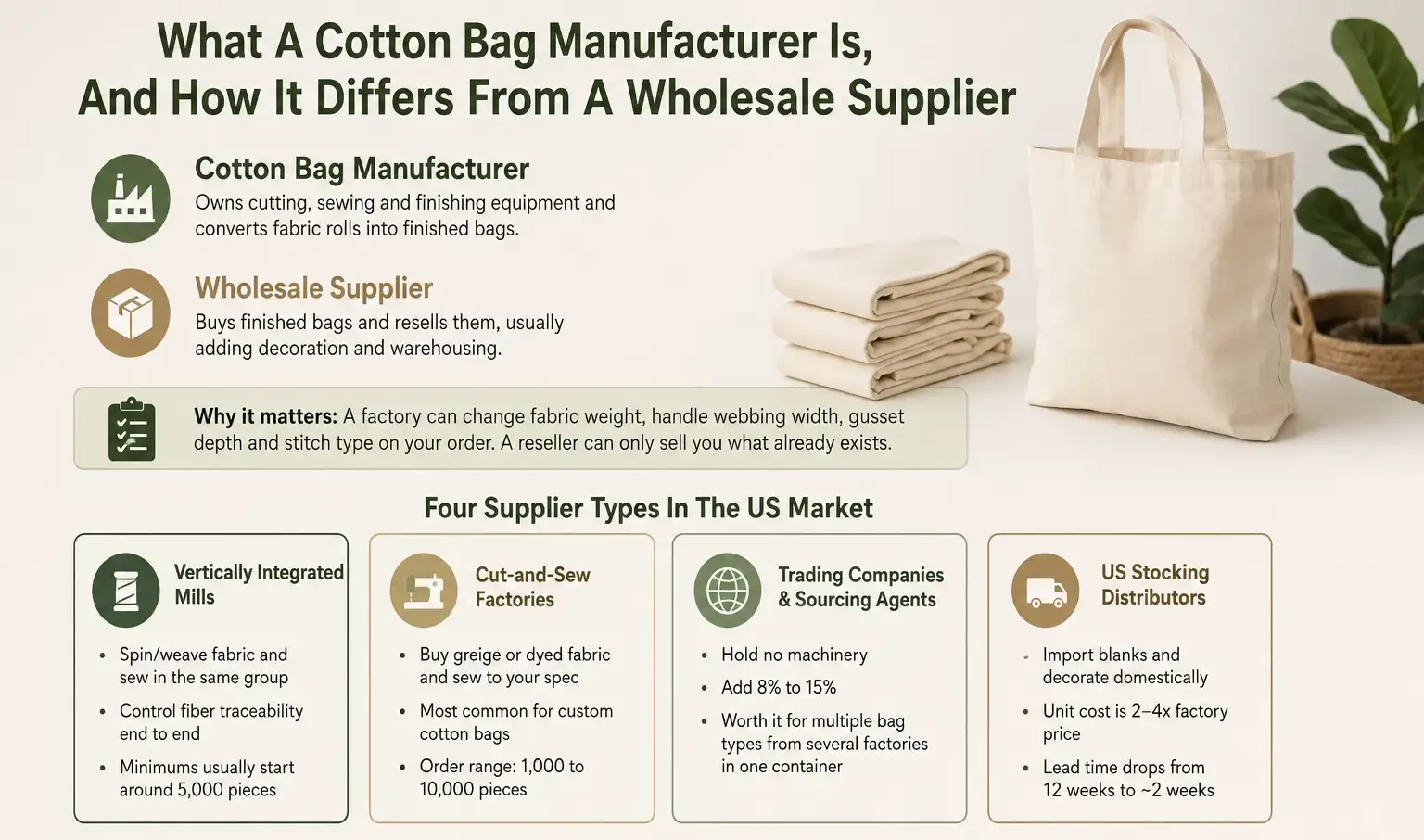
Vertically integrated mills spin or weave their own fabric and sew in the same group. They control fiber traceability end to end, which is what forced labor documentation requires. Minimums usually start around 5,000 pieces.
Cut-and-sew factories buy greige or dyed fabric and sew to your spec. This is the most common source for custom cotton bags at 1,000 to 10,000 pieces, and the one with the widest quality spread.
Trading companies and sourcing agents hold no machinery. They add 8% to 15% and are worth it when you need multiple bag types from several factories consolidated into one container.
US stocking distributors import blanks and decorate domestically. Unit cost runs two to four times the factory price, and lead time drops from twelve weeks to about two. This is the usual route for wholesale cotton tote programs that need reorders inside a quarter.
If you are still choosing between fabrics before choosing a factory, the comparison of jute, cotton and juco for wholesale branding sets out where each material earns its cost.
Cotton Bag Specifications That Decide Unit Price
Four variables account for most of the price difference between two quotes that look identical on paper. Get them written into the specification sheet before you request pricing.
1. Fabric Weight
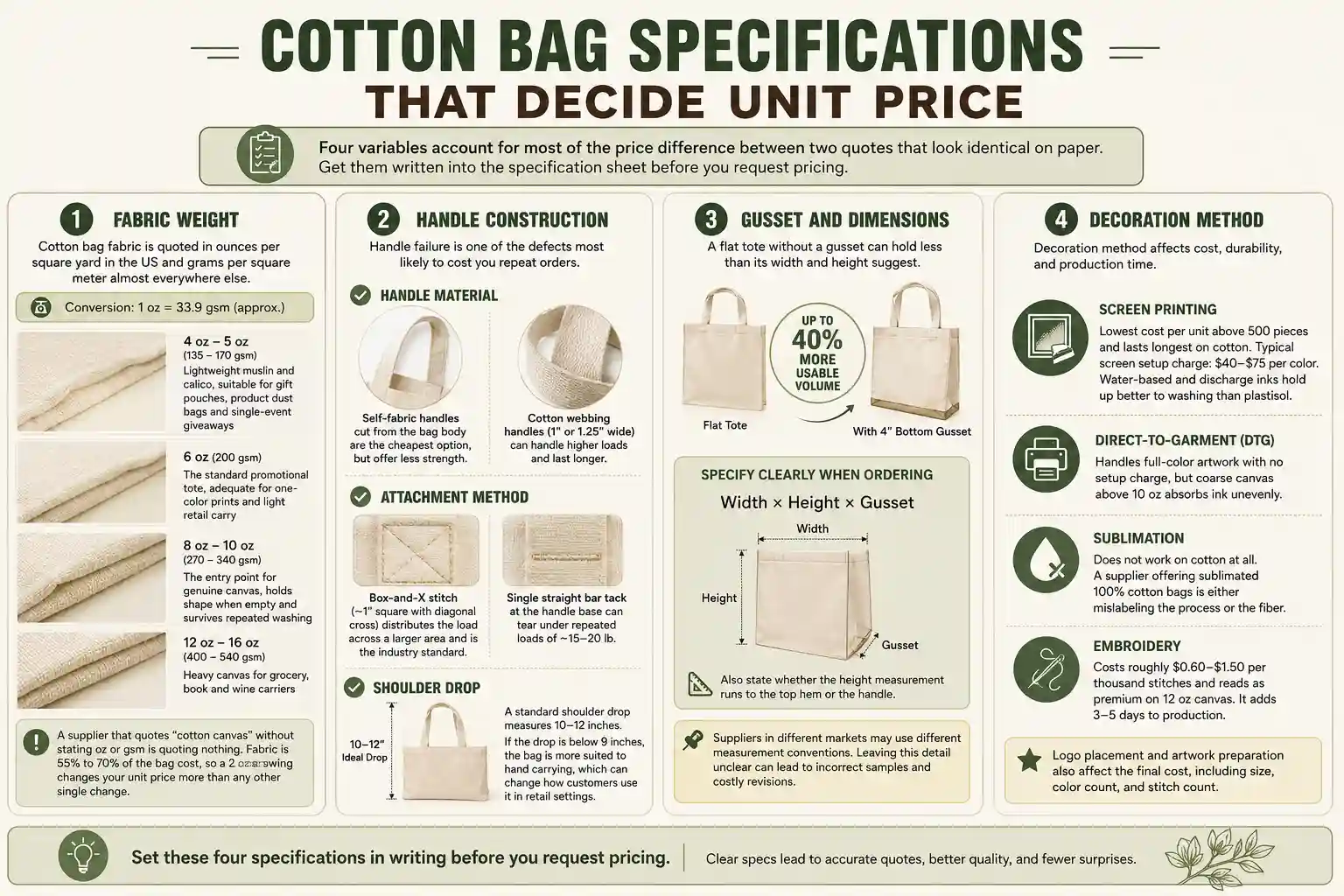
Cotton bag fabric is quoted in ounces per square yard in the US and grams per square meter almost everywhere else. The conversion is roughly 1 oz equals 33.9 gsm.
- 4 oz to 5 oz (135 to 170 gsm): lightweight muslin and calico, suitable for gift pouches, product dust bags and single-event giveaways
- 6 oz (200 gsm): the standard promotional tote, adequate for one-color prints and light retail carry
- 8 oz to 10 oz (270 to 340 gsm): the entry point for genuine canvas, holds shape when empty and survives repeated washing
- 12 oz to 16 oz (400 to 540 gsm): heavy canvas for grocery, book and wine carriers
A supplier that quotes “cotton canvas” without stating oz or gsm is quoting nothing. Fabric is 55% to 70% of the bag cost, so a 2 oz swing changes your unit price more than any other single change.
2. Handle Construction
Handle failure is one of the defects most likely to cost you repeat orders. Self-fabric handles cut from the bag body are the cheapest option, but they also offer less strength. Cotton webbing handles in 1-inch or 1.25-inch widths can handle higher loads.
The attachment method matters just as much as the handle material. A box-and-X stitch, which uses a roughly 1-inch square with a diagonal cross through it, remains a common industry standard because it distributes the load across a larger area. A single straight bar tack at the handle base can tear under repeated loads of around 15 to 20 lb.
A standard shoulder drop measures 10 to 12 inches. If the drop falls below 9 inches, the bag becomes more suited to hand carrying, which can change how customers use it in retail settings.
3. Gusset And Dimensions
A flat tote without a gusset can hold less than its width and height suggest. A 15 × 16-inch bag with a 4-inch bottom gusset can provide roughly 40% more usable volume than the same bag without one.
When placing an order, specify dimensions as width × height × gusset. Also state whether the height measurement runs to the top hem or the handle. Suppliers in different markets may use different measurement conventions, and leaving this detail unclear can lead to incorrect samples and costly revisions.
4. Decoration Method
Screen printing costs the least per unit above 500 pieces and lasts longest on cotton, with a typical screen setup charge of $40 to $75 per color. Water-based and discharge inks sit inside the weave and hold up better to washing than plastisol.
Direct-to-garment printing handles full-color artwork with no setup charge, but coarse canvas above 10 oz absorbs ink unevenly. Sublimation does not work on cotton at all, so a supplier offering sublimated 100% cotton bags is either mislabeling the process or the fiber.
Embroidery costs roughly $0.60 to $1.50 per thousand stitches and reads as premium on 12 oz canvas. It adds three to five days to production.
Logo placement and artwork preparation also affect the final cost, covered in this bulk order guide for custom logo bags.
What Cotton Bags Cost In 2026 And Where The Price Comes From
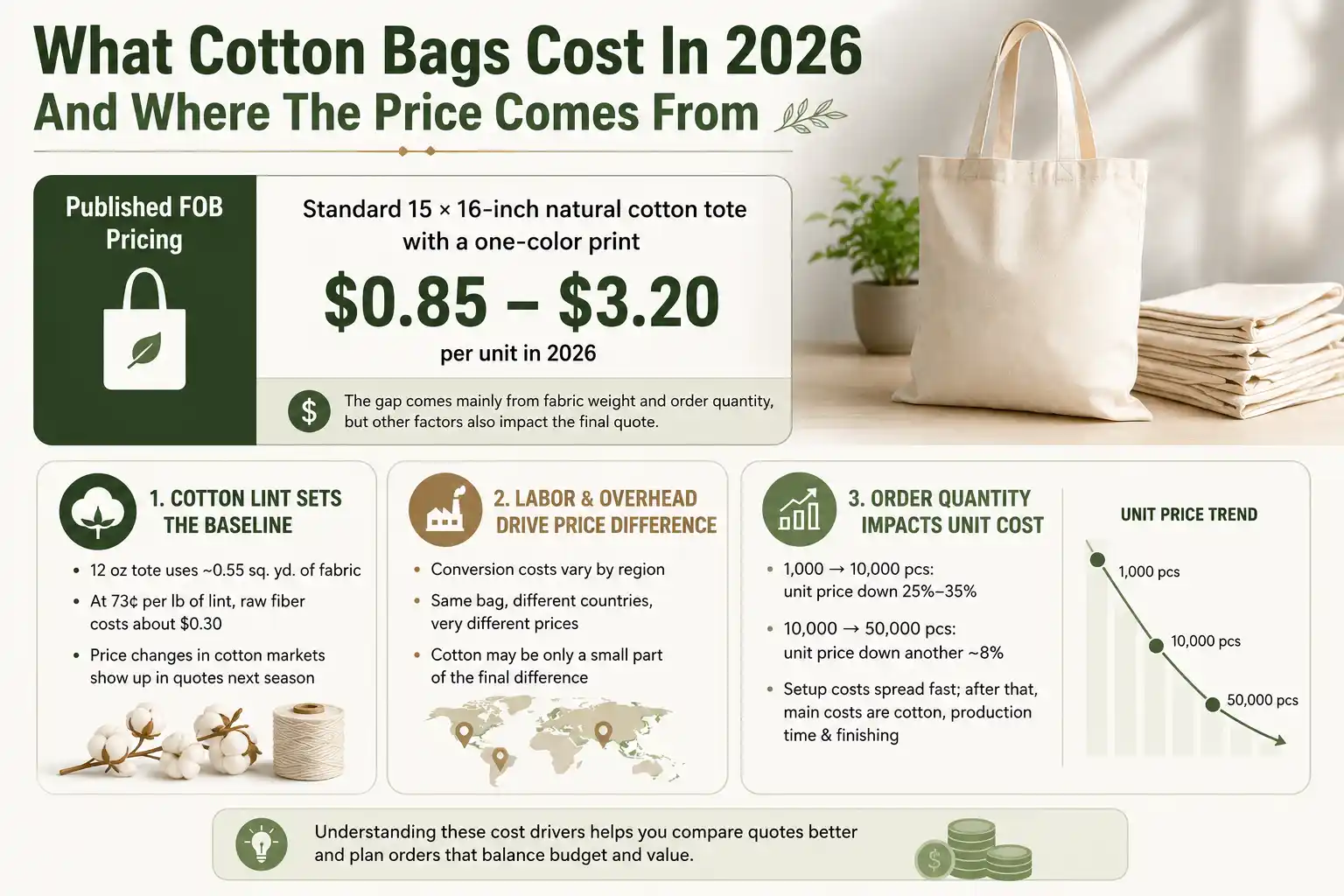
Published FOB pricing for a standard 15 × 16-inch natural cotton tote with a one-color print ranges from $0.85 to $3.20 per unit in 2026. The gap comes mainly from fabric weight and order quantity, but those are not the only factors behind the final quote.
Cotton lint sets the baseline. A 12 oz tote uses roughly 0.55 square yards of fabric. At 73 cents per pound of lint, the raw fiber costs about $0.30 before spinning, weaving, dyeing, cutting, sewing, and the factory’s margin. When USDA raises its cotton price forecast, buyers can see the effect in supplier quotes within the next buying season.
Labor and overhead create most of the difference between factory quotes. The same bag made in Tamil Nadu, Chittagong, Shandong, or New Hampshire can carry very different prices because conversion costs vary by market. The cotton itself may account for only part of the final difference.
Order quantity also affects the unit cost, but perhaps less than buyers assume. Increasing an order from 1,000 to 10,000 pieces can reduce the unit price by roughly 25% to 35%. Moving from 10,000 to 50,000 pieces may cut another 8%. Setup costs spread across more units quickly, after which the main costs come down to the cotton, production time, and finishing.
For a closer look at where minimum order quantities come from and how they affect pricing across different bag types, see this breakdown of minimum order quantities for custom printed eco bags.
Fob Is Not What The Bag Costs You
Supplier quotes stop at FOB, which covers the price at the origin port. The number that belongs in your margin calculation is the landed cost at your warehouse door.
Here is the full cost stack for a real container, using a 12 oz natural canvas tote at $1.60 FOB and a 40ft high-cube container holding roughly 99,000 bags across 990 export cartons.
| Cost component | Basis | Total | Per bag |
|---|---|---|---|
| FOB unit price | 99,000 × $1.60 | $158,400 | $1.6000 |
| Import duty | 6.3% of entered value, HTS 4202.92.15.00 |
$9,979 | $0.1008 |
| Ocean freight | Drewry WCI Shanghai to Los Angeles, 6 Aug 2026 |
$5,894 | $0.0595 |
| Merchandise Processing Fee |
0.3464%, capped at $651.50 per entry |
$549 | $0.0055 |
| Harbor Maintenance Fee | 0.125% of value, ocean cargo only |
$198 | $0.0020 |
| Landed before drayage | $175,020 | $1.7679 |
Two things in that table surprise most buyers. Duty costs almost twice as much as ocean freight on a full container. The entire import stack adds only 10.5% to FOB, which means a supplier quoting $0.20 less per bag can outweigh a tariff advantage in many cases.
The Drewry World Container Index put the Shanghai-to-Los Angeles spot rate at $5,894 per 40ft on 6 August 2026, compared with $7,893 for Shanghai to New York.
Once you add drayage, customs brokerage, deconsolidation and inland freight, a realistic landed cost for this example comes to around $1.80 to $1.85 per bag. Merchandise Processing Fee rates are set annually by CBP and run at 0.3464%, with a $33.58 minimum and $651.50 maximum for the year ending 30 September 2026.
Us Import Compliance For Cotton Bags
Three rules apply to every cotton bag entering the United States, and getting any of them wrong stops the container at the port rather than costing you a discount.
Classification And Duty
Cotton bags designed to carry goods classified in HTS heading 4202 as travel, sports and similar bags, not in chapter 63 with household textiles. The specific line is 4202.92.15.00, of cotton, at a 6.3% general rate, and it carries textile category 369.
The same bag in polypropylene or polyester falls under 4202.92.31 at 17.6%. That 11.3 point spread is a real reason US brands specify cotton over recycled PET for reusable programs, and it rarely appears in supplier comparisons.
The special rate column shows “A” for this line, meaning the code was GSP-eligible when travel goods were added to the program. That eligibility is dormant. GSP expired on 31 December 2020 and Congress has not reauthorized it, and India lost beneficiary status separately on 5 June 2019.
Chinese-origin bags may also carry Section 301 duties on top of the 6.3%. Section 301 survived the litigation that struck down the IEEPA tariffs on 20 February 2026, so check the current list assignment for your exact code before you commit to a China price.
Forced Labor And Cotton Traceability
The Uyghur Forced Labor Prevention Act, Public Law 117-78, creates a rebuttable presumption under 19 U.S.C. 1307 that goods made wholly or in part in the Xinjiang Uyghur Autonomous Region are inadmissible.
Xinjiang produces a large share of world cotton, so the presumption reaches far beyond Chinese factories.
CBP depends on the origin of the fiber, not the origin of the sewing. A bag cut and sewn in Vietnam from Xinjiang lint is inadmissible. Detention releases require a documented chain from the finished bag back to the gin and the field.
Ask any prospective supplier for four documents before sampling: the yarn purchase invoice, the mill’s fiber origin declaration, ginning records or equivalent, and transport documents linking each stage.
A factory that cannot produce these on request will not produce them under a Notice of Detention either.
Labeling And Origin Marking
Here is the rule almost everyone gets wrong. Tote bags and shopping bags are exempt from the Textile Fiber Products Identification Act, as the FTC states in its labeling guidance for the Textile and Wool Acts.
The exemption disappears as soon as you make a fiber content claim. Print “100% cotton” on the bag or hangtag, and you trigger the full disclosure requirement: generic fiber names by percentage in descending order, country of origin, and the manufacturer’s name or RN number.
Country-of-origin marking under 19 U.S.C. 1304 applies regardless of the textile exemption. Every imported bag must be legibly and permanently marked with its country of origin where the ultimate purchaser can see it. For a tote, that generally means a sewn-in label rather than a removable sticker.
Environmental claims also fall under the FTC Green Guides. A “biodegradable” claim requires evidence that the product will break down within one year under customary disposal conditions. A cotton bag sent to a landfill does not meet that standard, and unqualified “eco-friendly” claims are the type of claims the FTC has challenged in the past.
State Bag Laws Are Reshaping Us Cotton Bag Demand
The reusable bag market in the U.S. is shaped by regulation as much as by commercial demand. Roughly a dozen states restrict single-use carryout bags, and some of those rules changed materially this year.
California repealed its SB 270 reusable grocery bag certification program on January 1, 2026, under SB 1053. Stores may now provide only recycled paper bags at checkout for a minimum 10-cent charge. From January 1, 2028, those paper bags must contain at least 50% postconsumer recycled material.
The practical effect for cotton bag buyers is specific. California’s previous checklist for compliant reusable bags, which included a 125-use requirement and a 15-liter minimum capacity, no longer applies.
Cotton totes can now enter that market as retail merchandise or part of branded programs rather than as certified checkout bags. That removes a previous specification constraint and shifts more of the competition toward design, durability, and customer use.
If you are building an internal case for switching a bag program, the argument for replacing plastic bags with cotton is stronger on retail lifespan than on carbon impact, for reasons the next section examines more closely.
The Sustainability Claim You Can Actually Defend
Most supplier pages assert that cotton bags are better for the environment. The best available life cycle data says something more complicated, and knowing it protects you from a greenwashing complaint.
The Danish Environmental Protection Agency’s Life Cycle Assessment of Grocery Carrier Bags, Environmental Project no. 1985, found that a conventional cotton bag must be reused 52 times to beat a lightweight LDPE bag on climate change alone, and 7,100 times across all environmental indicators.
Organic cotton scores worse, not better, on that measure. The same study puts organic cotton at 149 reuses for climate and 20,000 across all indicators, because organic yields are lower so each bag carries more land and water burden.
Those numbers are not an argument against cotton bags. They are an argument for durability. A 12 oz canvas tote that survives 300 grocery trips beats a 5 oz promotional bag that is discarded after four, and the difference is entirely in fabric weight and handle construction.
Frame your claims accordingly. “Reusable” and “designed for X years of use” are defensible. “Sustainable” and “eco-friendly” without a substantiated basis draw regulatory attention.
End-of-life matters too, and how cotton and jute bags should be recycled or disposed of is worth stating on the product page.
Certifications: What Each One Actually Proves
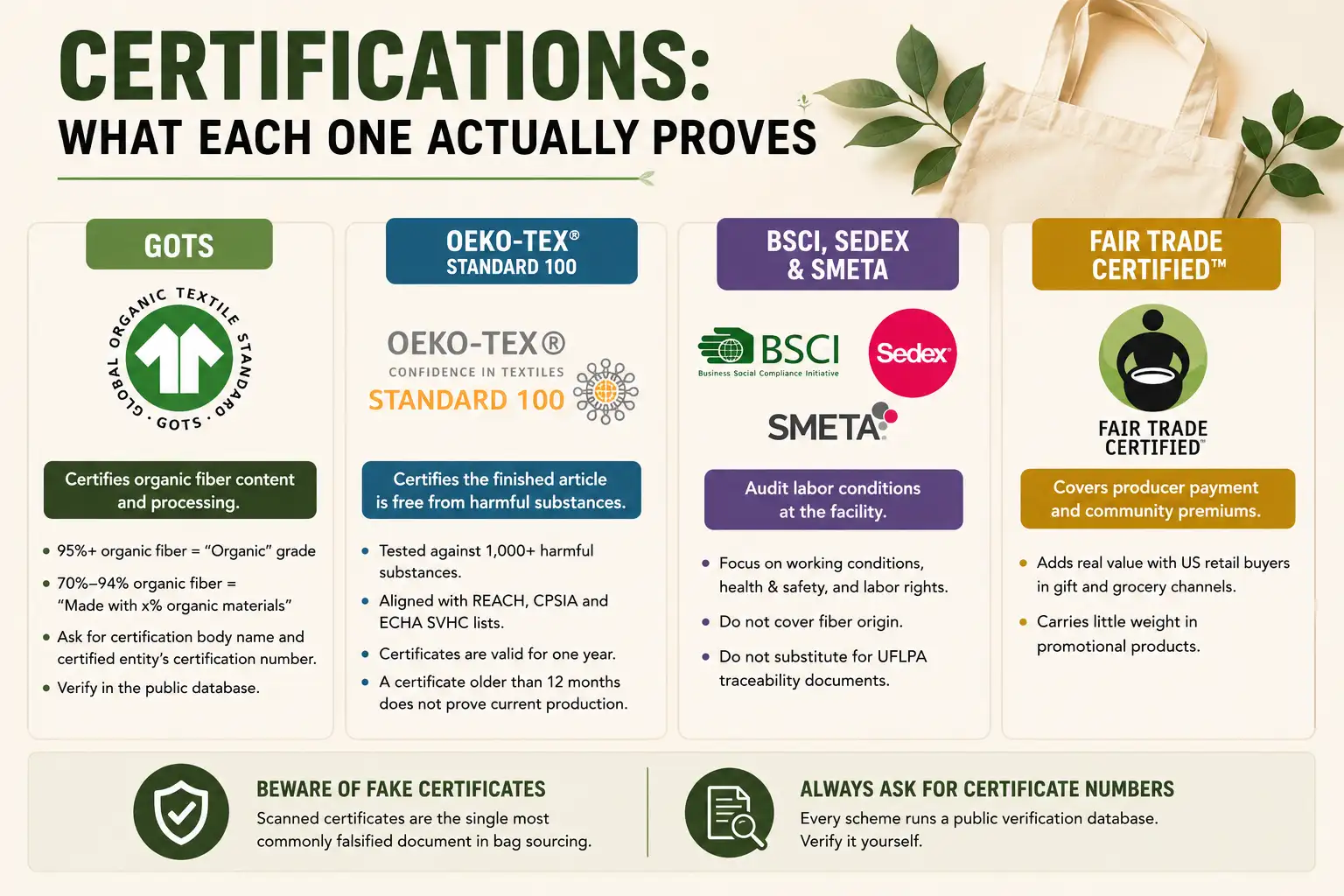
Suppliers list certifications as a wall of logos. Each proves something narrow, and buying the wrong one wastes money.
GOTS certifies organic fiber content and processing. The Global Organic Textile Standard label grades require 95% or more certified organic fiber for the “Organic” grade and 70% to 94% for “Made with x% organic materials”. A valid GOTS claim must show the certification body name and the certified entity’s certification number, so ask for both and verify them in the public database.
OEKO-TEX STANDARD 100 certifies that the finished article has been tested against more than 1,000 harmful substances, aligned with REACH, CPSIA and ECHA SVHC lists. Certificates are valid for one year, which means a certificate dated more than twelve months ago proves nothing about current production.
BSCI, Sedex and SMETA audit labor conditions at the facility. They say nothing about fiber origin, so they do not substitute for UFLPA traceability documents.
Fair Trade Certified covers producer payment and community premiums. It carries real weight with US retail buyers in the gift and grocery channels and almost none in promotional products.
Ask for certificate numbers rather than PDFs. Scanned certificates are the single most commonly falsified document in bag sourcing, and every one of these schemes runs a public verification database.
Inspecting A Production Run Without Guessing
“Check the quality” is not a plan. US buyers should specify an inspection standard in the purchase order, and the one the trade uses is ANSI/ASQ Z1.4.
Under General Inspection Level II at AQL 2.5, a 5,000 unit lot draws code letter L and a sample of 200 bags. Ten or fewer major defects and the lot passes. Eleven or more and it fails. Write those numbers into the PO so the pass criterion is not negotiated after the goods are made.
A workable defect schedule for cotton bags looks like this.
Critical: any needle or metal contamination, any wrong country of origin marking.
Major: handle detaching under load, seam skipped over more than 1 inch, print misregistration over 3 mm, dimensions out of tolerance by more than 0.5 inch, visible staining, shade variation between bags in the same carton.
Minor: loose thread ends, hem width variance under 3 mm, minor ink haze outside the print area.
Inspect before the goods leave the factory, not on arrival. A pre-shipment inspection at 80% packed costs $250 to $400 and is the cheapest insurance in the entire transaction.
One defect shows up only after the container arrives: mildew from moisture trapped during a five-week ocean crossing. Specify desiccant in every carton and moisture content below 8% at packing.
If bags do arrive with a stale odor, removing musty smell from cotton totes is usually possible, but it costs you the reorder window.
Comparing Sourcing Countries For The Us Market
Origin choice affects duty exposure, lead time and forced labor risk simultaneously. All origins below pay the same 6.3% MFN rate under 4202.92.15.00 unless a free trade agreement applies, so the differences sit elsewhere.
| Origin | Typical MOQ | Production lead time |
Strengths | Watch for |
|---|---|---|---|---|
| India | 1,000 to 5,000 | 30 to 45 days | Organic and GOTS depth, strong handloom and canvas capability, competitive on 8 oz and above | GSP dormant since 2019, monsoon capacity dips |
| Bangladesh | 5,000 to 10,000 | 35 to 50 days | Lowest conversion cost at volume, mature woven sewing base | Higher MOQs, fabric often imported so traceability needs checking |
| China | 500 to 3,000 | 20 to 35 days | Fastest sampling, widest decoration options, best small-run flexibility | Section 301 exposure, UFLPA cotton origin scrutiny |
| Vietnam | 3,000 to 10,000 | 30 to 45 days | Strong compliance culture, good for mixed material programs | Cotton is imported, so fiber origin documents are mandatory |
| Turkey | 500 to 2,000 | 20 to 30 days | Domestic cotton, short lead times to US East Coast | Higher unit cost, smaller factory base for very large runs |
| United States | 100 to 500 | 10 to 20 days | Made in USA claim, no import risk, fast reorders | Two to four times the unit cost, limited fabric weight options |
Lead time in that table is production only. Add 25 to 35 days for ocean transit from South Asia to the US West Coast, plus five to ten days for customs clearance and inland movement. A January delivery means a September purchase order.
For a step-by-step version of the vetting sequence, the wholesale bag buying checklist applies to cotton as directly as it does to jute, and the production process breakdown shows where the approval gates sit.
Red Flags In A Cotton Bag Quote
Some warning signs are visible before you ever request a sample.
A price quoted without a stated fabric weight means the supplier intends to choose the weight later. A quote that omits Incoterms leaves you guessing whether inland transport to the port is included.
A factory that accepts your delivery date without asking about artwork approval timing has not built a reverse schedule, and will miss it.
Full customization offered below a 100 piece minimum almost always means heat transfer applied to purchased blanks, which is a reseller with a printer, not a manufacturer.
The most useful test is asking for a photograph of the specific sewing line that will run your order, taken this week. Factories that have one produce it in a day. Agents presenting as factories do not.
The One Thing Worth Doing Differently
Most sourcing failures here trace back to a specification sheet too vague to enforce. Write fabric weight in oz and gsm, handle width and attachment stitch, gusset depth, print method and ink type, packing with desiccant, and the AQL standard with its accept and reject numbers.
A supplier who pushes back on any of those lines is telling you something useful before you have spent anything. That conversation costs a day. A rejected container costs a season.
Frequently Asked Questions
Categories
Latest Post
-
-

July 31, 2026
Jute Bags Manufacturer: The Complete B2B Sourcing Guide
-
July 24, 2026
Cotton Tote Bags Wholesale: The 2026 Bulk Buyer’s Guide


What is the tariff code for cotton tote bags?
What is a realistic minimum order for custom cotton bags?
How much do wholesale cotton tote bags cost in 2026?
Which fabric weight should I order?
Are cotton bags better for the environment than plastic bags?
Do cotton tote bags need a fiber content label in the United States?
Which country is best for cotton bag manufacturing?
How long does a cotton bag order take from PO to the warehouse?
