
Cotton Tote Bags Wholesale: The 2026 Bulk Buyer’s Guide
-

24th Jul, 2026
-

(0)

By : Sara International
Sourcing cotton tote bags wholesale looks simple until three quotes land in your inbox and none of them line up. One is FOB Mumbai, another is DDP to your warehouse, and the third quotes 140 GSM fabric when you specified 220. Only one includes the 6.3 percent US import duty on cotton bags under HTS 4202.92.15.
Demand continues to grow because regulations continue to change. Twelve states now restrict single-use plastic carrier bags at retail, while several others operate bag fee programmes, according to the National Conference of State Legislatures.
Cotton is not automatically the cleaner alternative. A life cycle assessment by the Danish Environmental Protection Agency found that a conventional cotton bag reaches its climate break-even point after 52 reuses, while an organic cotton bag requires 149. Durability, not material alone, determines sustainability.
That is why fabric weight and stitching matter more than the label. If you are still deciding on a base fabric, this comparison of jute, cotton, and juco for wholesale branding explains the trade-offs, while a standard cotton bag range shows the specifications most mills treat as the default.
What Cotton Tote Bags Wholesale Pricing Actually Covers
A per-bag price means very little without the Incoterm attached to it. Ex Works, FOB, and DDP assign cost and risk at completely different stages, and the ICC Incoterms rules define exactly where that responsibility shifts. Two quotes based on different terms are not directly comparable.
Create a landed cost model before you shortlist suppliers. The breakdown below shows how a typical bulk cotton tote bag order is priced by the time the container reaches a US warehouse.
| Cost line | Share of landed cost | What moves it |
|---|---|---|
| Blank bag at origin | 55 to 70 percent | GSM, finished size, gusset, handle length |
| Printing and setup | 10 to 25 percent | Colour count, print method, screen fees |
| Ocean freight and drayage | 8 to 15 percent | Priced on volume, and totes are bulky |
| US import duty | 6.3 percent of customs value | HTS 4202.92.15, cotton bags |
| Brokerage, ISF, customs bond | 2 to 4 percent | Largely fixed per shipment |
That last row explains why small orders cost more than they appear to. Fixed shipment charges stay the same whether you order 500 bags or 5,000, so a trial run can carry three times the per-unit overhead of a production run.
Air freight helps meet a deadline, but it rarely makes financial sense. On a 1,000-piece order, it can add more to the cost of each bag than the printing itself. In most cases, businesses use air freight to recover from an artwork delay, when a structured bulk ordering process for custom logo bags could have prevented it in the first place.
Fabric Weight and GSM: The Number That Decides Everything Else
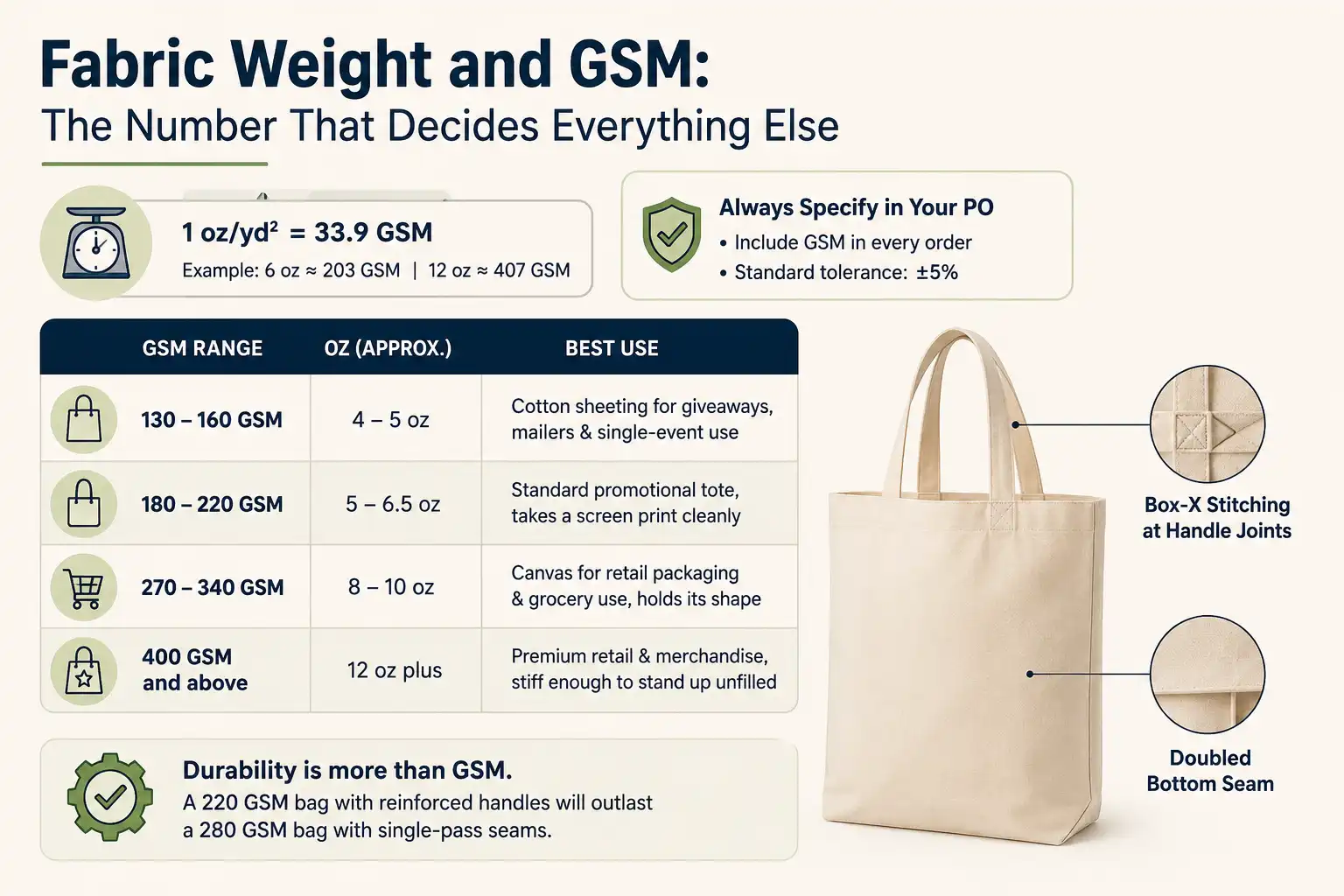
Most supplier disputes come down to one number. US buyers work in ounces per square yard, while most Asian and European mills quote GSM. The conversion is simple: 1 ounce per square yard equals 33.9 GSM. A 6 oz tote is roughly 203 GSM, while a 12 oz canvas comes to about 407 GSM.
Always include the GSM in your purchase order, along with an acceptable tolerance, because fabric weight naturally varies between production runs. A tolerance of ±5% is both standard and enforceable. Without it, a supplier can deliver 190 GSM against a verbal 220 GSM specification and still remain technically compliant.
- 130 to 160 GSM (4 to 5 oz): cotton sheeting for giveaways, mailers and single-event use.
- 180 to 220 GSM (5 to 6.5 oz): the standard promotional tote, and the weight that takes a screen print most cleanly.
- 270 to 340 GSM (8 to 10 oz): canvas for retail packaging and grocery use, holds its shape when loaded.
- 400 GSM and above (12 oz plus): premium retail and merchandise, stiff enough to stand up unfilled.
Fabric weight is not the only measure of durability, but many buyers focus on it first. Handle attachment is where most bags fail, so specify box-X stitching at the handle joins and a doubled bottom seam. A 220 GSM bag with reinforced handles will outlast a 280 GSM bag with single-pass seams.
Reading MOQ and Quantity Tiers Without Overbuying
Bulk savings come from spreading fixed costs, not from cheaper fabric. Screen setup, pattern making, sampling, and container space cost the same whether you order 250 units or 2,500. Fabric and labour costs change very little, which is why the price curve flattens sharply beyond roughly 5,000 pieces.
The steepest price drop comes between 250 and 1,000 units, where most buyers save 20 to 30 percent on the per-unit price. Beyond 10,000 units, expect only single-digit gains. Negotiate payment terms or freight allocation instead of pushing for a lower unit price.
Quantity is not your only cost lever. Dropping a gusset, shortening handles by two inches, or cutting to a standard fabric width can all reduce costs without changing the fabric grade. Factory capabilities also vary considerably, so check the realistic minimum order quantity for custom printed eco bags before building your budget around a marketplace listing.
The programme type also changes the numbers. A retail packaging run usually keeps the same specification across repeat orders, while a corporate gifting programme places smaller repeat orders with fresh artwork each time. Lock the fabric specification once and change only the print.
How to Verify an Organic or Certified Claim Before You Pay
Almost every wholesale supplier claims organic cotton somewhere on its site. Far fewer can produce the document proving your shipment was organic, and that gap is where buyers get exposed.
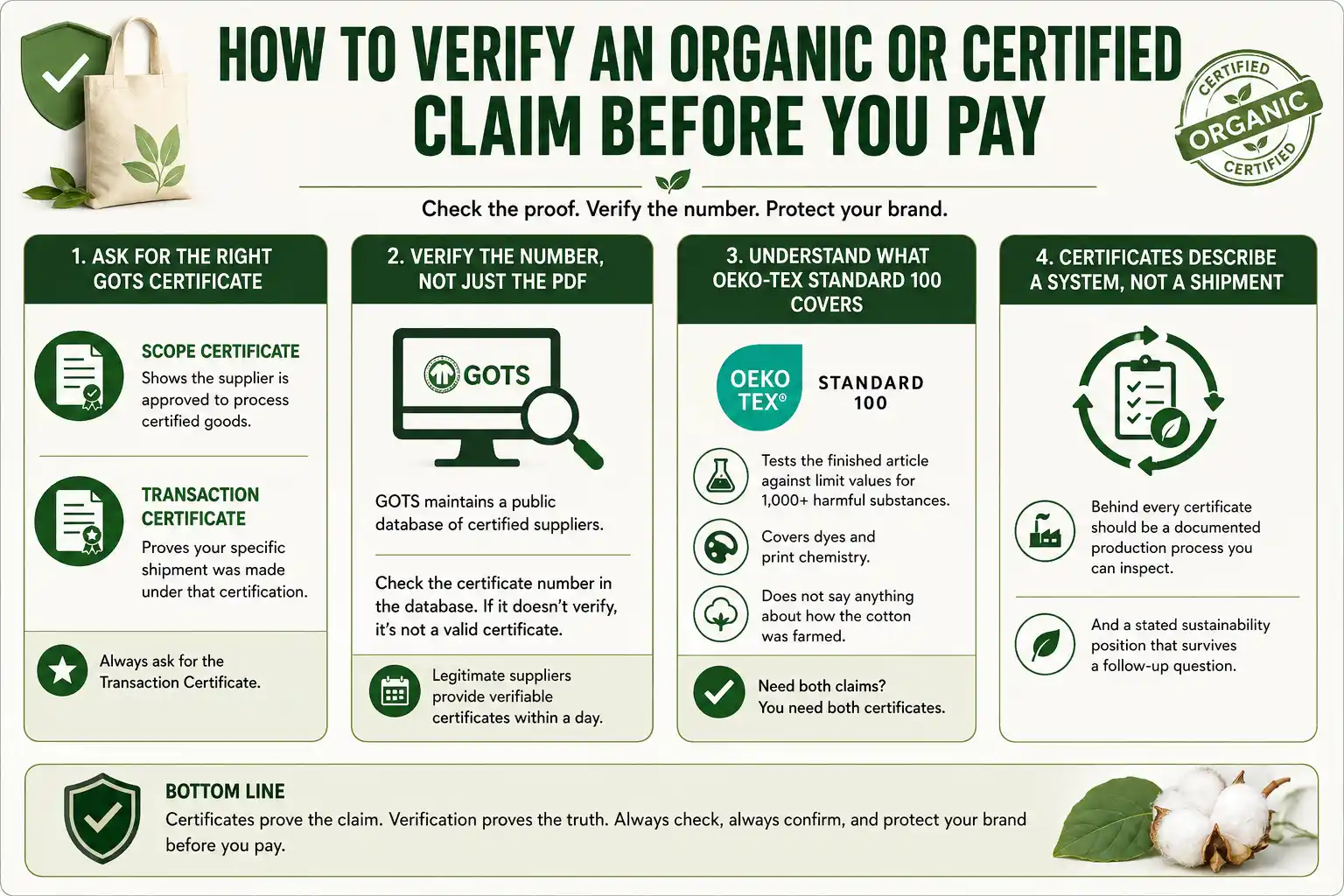
GOTS issues two different certificates and they do different jobs. A Scope Certificate shows the supplier is approved to process certified goods. A Transaction Certificate proves your specific shipment was made under that certification. Ask for the Transaction Certificate.
Then check the number, not the PDF. GOTS maintains a public database of certified suppliers, and a certificate that will not verify against it is not a certificate. Suppliers who actually hold the paperwork produce it within a day.
OEKO-TEX STANDARD 100 answers a different question entirely. It tests the finished article against limit values for more than 1,000 harmful substances, which covers dyes and print chemistry, but it says nothing about how the cotton was farmed. If you need both claims, you need both certificates.
Certificates describe a system, not a shipment. Behind either one should sit a documented production process you can inspect and a stated sustainability position that survives a follow-up question.
Pre-Shipment Inspection and US Labelling Compliance
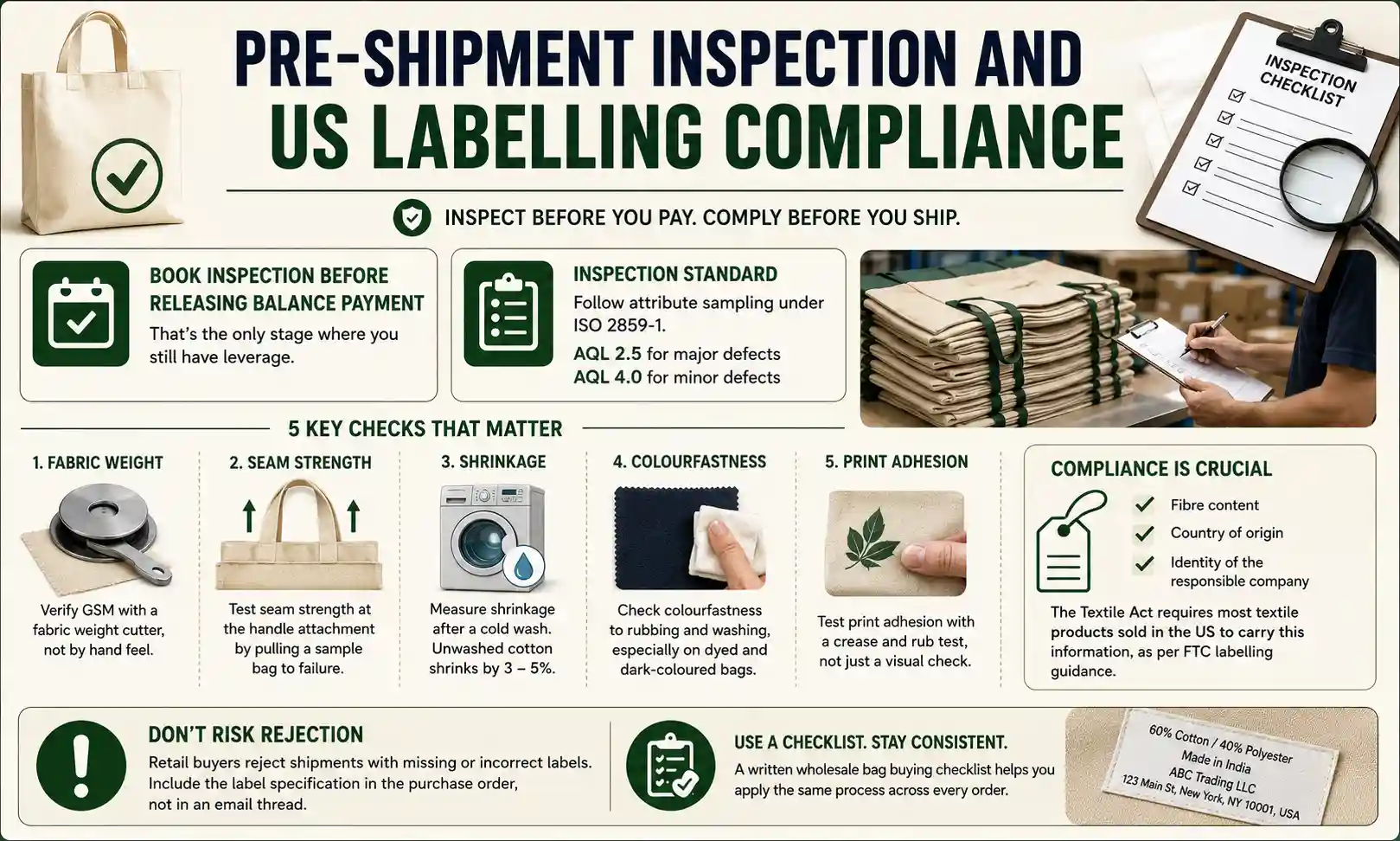
Book the inspection before releasing the balance payment. That is the only stage where you still have leverage, yet it is the step first-time bulk buyers skip most often.
Inspections follow attribute sampling under ISO 2859-1, which defines how many units inspectors pull from a lot and how many defects they can accept. An AQL of 2.5 for major defects and 4.0 for minor defects is a standard commercial benchmark for promotional textiles.
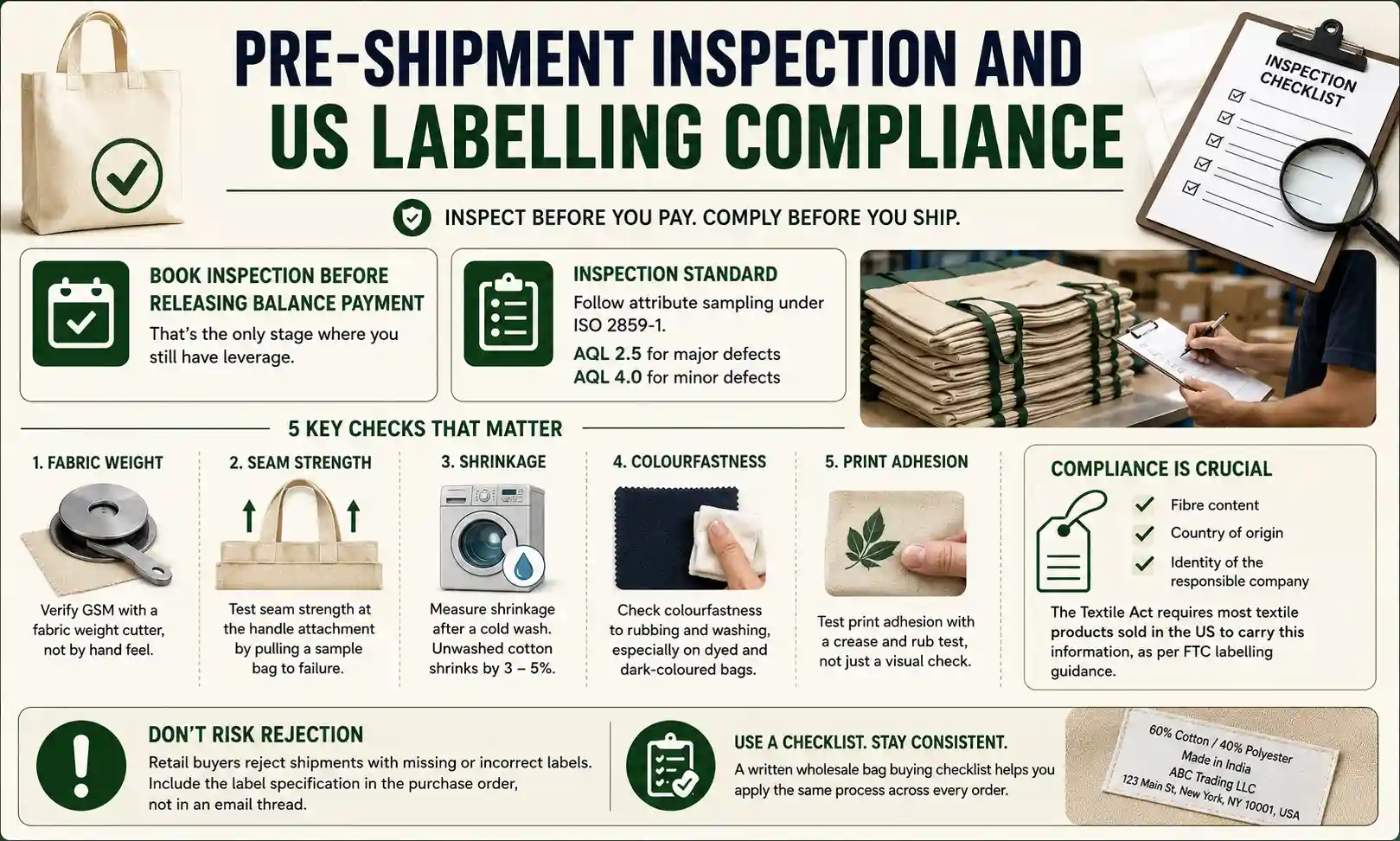
Five checks justify the inspection cost on a cotton tote order:
- Verify GSM with a fabric weight cutter rather than by hand feel.
- Test seam strength at the handle attachment by pulling a sample bag to failure.
- Measure shrinkage after a cold wash, as unwashed cotton commonly shrinks by 3 to 5 percent.
- Check colourfastness to rubbing and washing, especially on dyed and dark-coloured bags.
- Test print adhesion with a crease and rub test rather than relying on a visual inspection.
Compliance is the other half of the shipment. The Textile Act requires most textile products sold in the US to carry fibre content, country of origin, and the identity of the responsible company, as set out in the FTC labelling guidance.
Retail buyers reject shipments with missing or incorrect labels, so include the label specification in the purchase order instead of leaving it in an email thread. A written wholesale bag buying checklist helps you apply the same process across every order.
Mistakes That Cost Bulk Buyers the Most
- Approving a digital mockup instead of a physical pre-production sample. Ink behaves differently on 220 GSM cotton than it does on a screen.
- Specifying “natural” without a signed swatch. Undyed cotton varies between production lots, and the shade you approve may not match the shade you receive.
- Ordering unwashed bags for a retail programme. The first wash can reduce the finished height by almost an inch.
- Booking production before finalising the artwork. Revisions, not factory capacity, account for most missed delivery dates.
- Storing stock in a damp warehouse. Cotton absorbs odours quickly, and removing a musty smell from cotton totes takes far more effort than storing them in a dry environment.
- Ignoring end of life in a sustainability claim. Buyers now ask about it, and responsible disposal and recycling of cotton bags should form part of the answer.
What to Lock Down Before You Sign
Four things belong in the purchase order and nowhere else: GSM with a stated tolerance, finished dimensions including handle drop and gusset depth, label content, and the inspection standard. Everything else can wait for an email. Those four cannot.
Once those specifications are locked in, the commercial logic is simple. A tote only pays back its footprint through reuse, so investing in heavier fabric and stronger handles is the more economical decision over a two-year programme.
That is also why the case for switching from plastic to cotton depends entirely on how long the bag stays in use. A bag discarded after a single event was never the cheaper option.
Frequently Asked Questions
Categories
Latest Post
-

-
July 31, 2026
Jute Bags Manufacturer: The Complete B2B Sourcing Guide
-
July 24, 2026
Cotton Tote Bags Wholesale: The 2026 Bulk Buyer’s Guide

What is a typical MOQ for wholesale cotton tote bags?
How much do cotton tote bags cost in bulk?
Is 6 oz or 12 oz cotton better for promotional bags?
Do imported cotton tote bags need a label?
How long does a bulk cotton tote order take?
Are organic cotton totes worth the premium?
