

How to Import Organic Jute Bags from India to the USA — A step-by-step guide
-

24th Feb, 2026
-
(0)


By : Sara International
The US consumers are actively choosing eco-friendly products. Retailers are trying to meet the demand. The same goes for corporate brands as well. Organic jute bags have thus become popular for packaging and gifting.
Jute is a natural fibre, so it is biodegradable. Organic jute also has low production energy and needs fewer chemicals. Their exclusive properties make them a far better choice than single-use plastics.
That being said, the United States mostly imports organic jute bags from other countries. One of the major reasons behind this is that jute is a tropical crop. It requires climatic conditions and water-intensive processing (retting) that are not available in the US. Plus, it can be quite expensive.
However, the import process can be quite complicated if you are not familiar with it. This article explores all the details of how you can import Organic Jute Bags from India to the USA:
Why Import Organic Jute Bags from India
When it comes to importing, a little research goes a long way. This means, when you consider purchasing organic jute bags from India, you will get:
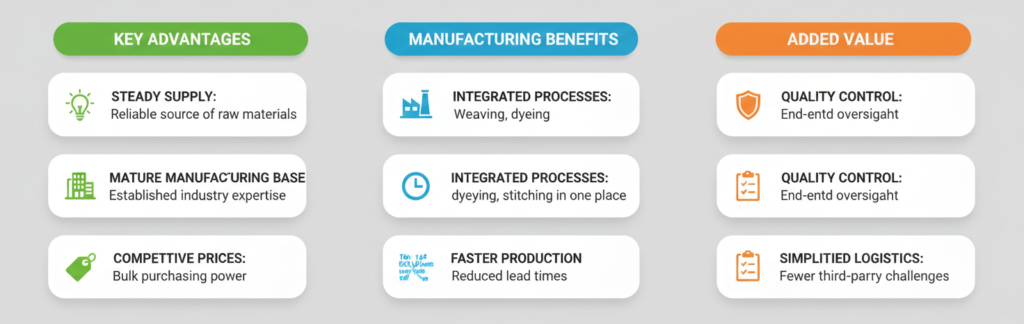
- A steady supply,
- A mature manufacturing base, and
- Competitive prices when you buy in bulk.
Many Indian manufacturers manage the entire process in one place, from weaving the jute fabric to dyeing and stitching the final bag. This makes the process much faster and you don’t have to worry about third-party challenges.
What to Look into When Choosing a Jute Bag Manufacturer
There are a few things to look into, for instance:
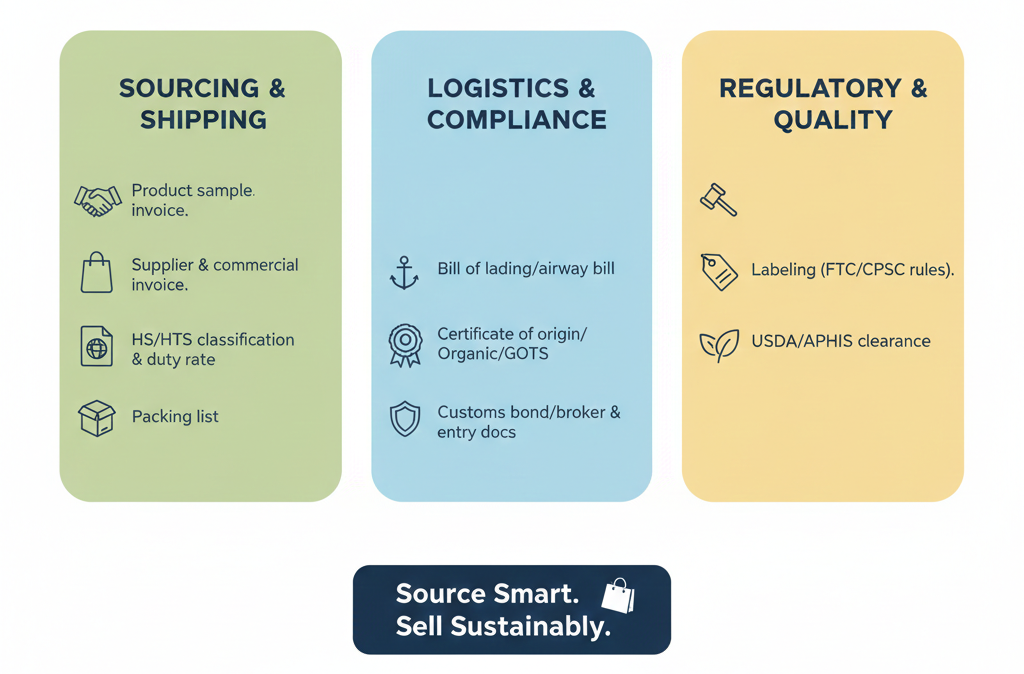
- Supplier & commercial invoice.
- Product sample.
- HS/HTS classification and estimated duty rate.
- Packing list.
- Bill of lading/airway bill.
- Certificate of origin and any organic/GOTS paperwork.
- Customs bond or broker, entry documents.
- Labeling that meets FTC/CPSC rules (fiber content, country of origin).
- USDA/APHIS clearance if required for plant-based goods.
How to Smoothly Import Organic Jute Bags
Importing products from countries like India can give you more cost benefits when done right. Here are a few things you need to know
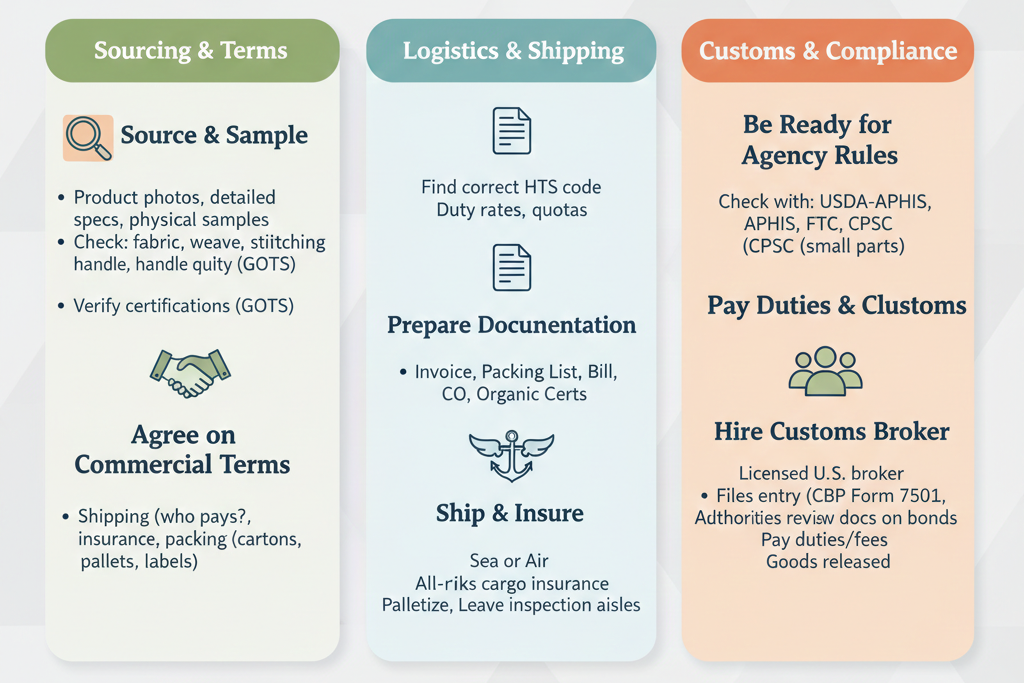
1. Source & sample
Before confirming a bulk order, ask the supplier for:
- clear product photos,
- detailed specifications, and
- physical samples.
For jute bags, you need to check:
- fabric thickness,
- weave density,
- stitching strength, and
- handle attachment.
Since jute is a natural fiber, look closely at uniformity in texture and colour. Make sure the bag feels sturdy enough for the weight it’s meant to carry.
2. Verify certifications
You can’t just say any product is organic. You have to make sure whether the product verifies that claim properly. Ask the supplier for a valid certification, such as GOTS (Global Organic Textile Standard) or other recognized organic textile certification.
3. Agree on commercial terms
Before placing your order, you need to agree on the shipping terms with your supplier. Decide who will pay for
- transportation,
- insurance, and
- handling charges.
For example, some agreements mean the supplier handles shipping until the goods leave India, while others include delivery to a U.S. port.
Also, confirm how the bags will be packed. Will they be packed in cartons? Will cartons be placed on pallets? Each carton should have clear labels showing product details, quantity, and country of origin.
4. Classify the goods (HS/HTS)
Work with your supplier or broker to find the correct HTS code for jute bags. This determines duty rates and whether special quotas or restrictions apply.
5. Prepare documentation
You’ll need:
- A detailed commercial invoice.
- Packing list.
- Bill.
- Certificate of Origin.
- Organic certificates.
6. Ship & insure
You can choose between sea and air. It usually varies based on cost or how fast you need them. For containers, palletize and leave inspection aisles if requested. Ensuring the cargo “all risks” is common for international shipments.
7. Hire a customs broker
Textiles are trade-sensitive. CBP and other agencies may inspect textile shipments more often, so hire a licensed U.S. customs broker to file the entry (CBP Form 7501 or equivalent electronic filing). The broker will calculate duties, advise on bonds, and help you meet “reasonable care” standards called out in the CBP guide.
8. Be ready for agency rules
Plant-based items can attract agency attention. You may need to check with
- USDA-APHIS
- FTC, or
- CPSC if there are small parts.
9. Pay duties and clear customs
After your shipment reaches the U.S., customs authorities will review the documents and may inspect the goods. Once the required duties and fees are paid and everything is approved, the shipment will be cleared for release.
How to Avoid the Common Mistakes
Importing products to the US can be quite complicated. Many first-time buyers often make mistakes and get trapped with compliance challenges. Here are a few common mistakes you should try to avoid:
- Wrong HTS code
- Poor labeling
- Missing organic proof
- Improper packing
Final Thoughts
Importing is a smart decision if you are planning to buy in bulk. Importing organic jute bags from India can turn out to be a smart investment for your business. However, you should stay prepared. Start small with samples. Lock in the paperwork. Work with a customs broker. And that’s how you avoid unnecessary penalties.
FAQs
1. What is the minimum order quantity when importing from India?
Most manufacturers start between 1,000–5,000 pieces, depending on size and customization.
2. How long does it take to import organic jute bags from India?
Production can take from 2–4 weeks with sea shipping adding up to 4–6 weeks.
3. Do I need a license to import jute bags into the USA?
No special license is usually required, but customs registration is necessary.
4. Is GOTS certification mandatory for organic claims?
Not mandatory legally, but highly recommended for credibility and retail acceptance.
5. Can I customize logo printing on bulk jute bags?
Yes, most Indian exporters offer private labeling and custom printing.
6. Is sea freight cheaper than air freight for bulk orders?
Yes, sea freight is significantly cheaper for large shipments.
Latest Post
-
February 25, 2026
How US Corporate Gifting Is Moving Towards Eco-Friendly Tote Bags
-
-
January 30, 2026
Juco Laptop Bags for Minimalists with Everyday Hustle




FSA
