
Quality
What we check, and why.
A guest never reads a specification sheet, but notices a slipper that sits unevenly or a logo set a little off centre. In a luxury room, quality is those details, held the same in every room, so quality control for custom hotel supplies starts with one object, the sample you approve. Everything we make afterwards is checked against it, at three points, before anything is packed. If you buy for a hotel or run its housekeeping, this page says what is checked, when, and what it means in a guest room.
Your design stays confidential; NDA on request.Certificates: documents shared with buyers on request.
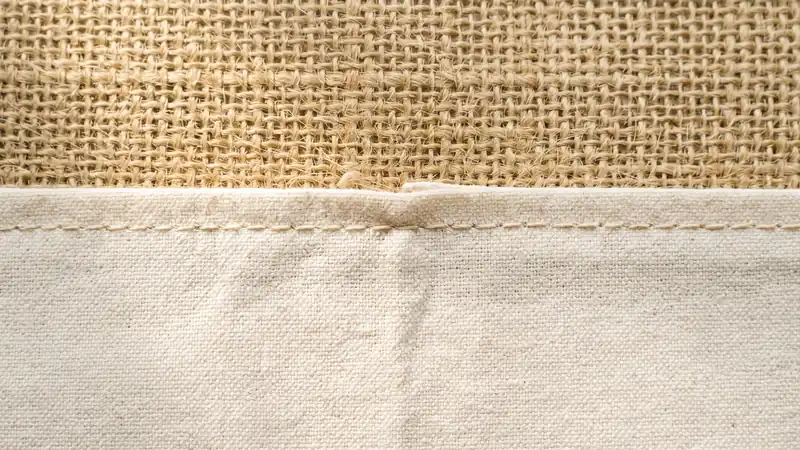
Images are illustrative. Every piece is made to your design, and client work is never shown.
Up close
The details we check
Each finished item is checked for defects in material, colour, print and stitching, against the sample you approved.
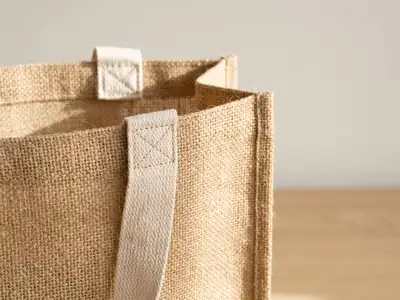
- The handles are sewn to take weight.
- Jute fabric is sourced and inspected for uniformity, strength and cleanliness before it is used.
- Stitched bags are checked for defects in material, colour, print and stitching.
When
Three points where goods are checked
- When material arrivesFabric is inspected before it is used, for uniformity, strength and cleanliness.
- During makingChecks are run in line during stitching, printing and embroidery.
- Before packingEach finished item is checked for defects in material, colour, print and stitching. Items that do not pass are reworked or rejected.
The shipment itself is then checked for accuracy and quantity before it leaves.
The approved sample is the standard
A custom item has no catalogue specification to fall back on, so the sample you sign off becomes the specification. It fixes the design, the colour, the size and the placement of the logo. Bulk production begins only after you approve it.
Treat the sample as a working document. Measure it. Use it. Put it through whatever the item will meet in your property. What you approve is what we are held to. If delivered goods do not match the approved sample, send us photographs; we investigate and work with you on a resolution.
What we check, and why it matters to a hotel
| What is checked | Against what | Why it matters in the property |
|---|---|---|
| Fabric: uniformity, strength, cleanliness | The fabric of the approved sample | A set of rooms should look like one set. Uneven cloth shows when items sit side by side on a housekeeping trolley. |
| Colour | The approved sample | Your brand colour is the first thing a guest reads. On natural fibre a colour matched to a Pantone reference is approximate and varies with the fibre, so the reference is the sample itself; a colour chart is no substitute. |
| Logo and print: alignment and placement | The approved sample | A logo that sits a little off centre looks like a mistake on every bag in the wardrobe. |
| Size | The approved sample | A laundry bag has to fit its hook or shelf, and a slipper has to fit a foot. |
| Stitching and seams | The approved sample | Seams carry the load, so a weak seam is where a full bag gives way. |
| Handles | Sewn to take weight | A beach bag or a laundry bag is lifted full, many times. |
| Finish | The approved sample | Loose threads and uneven edges are small, and they are what a guest sees up close. |
| Packing: grouping and labels | Your packing requirement | Goods grouped by size, colour or design, with labels, can be received and put away without sorting. |
Cut pieces are made from templates, so that the first piece and the last piece of a run are the same shape.
AQL and sampling inspection, in ISO’s terms
Buyers often ask for “an AQL inspection”. The term has a precise meaning.
AQL stands for acceptance quality limit. ISO describes it as “the maximum average percentage of defective items considered acceptable”, and the standard applies to “any series of lots produced by a single process or supplier”. ISO 2859-1 is the international standard that, in ISO’s words, “defines a system of acceptance sampling plans for inspection by attributes”. The current edition is ISO 2859-1:2026. In practice an inspector draws a sample from a lot instead of checking every item. The plan fixes how many to draw and how many defects the sample may show.
An AQL level is agreed in the order, usually set by the buyer. It is not a property of a factory. That is why this page states no AQL level for our goods: a level means something only when it is written into an order and applied, lot by lot, under a named sampling plan. If your brand standard sets one, state it with your order.
An inspection by a third party is a step in an order where you want one. Who appoints the inspector is agreed with the order.
What is not published
We publish no laboratory test data for our goods. That covers wash-cycle, shrinkage, colour-fastness and seam-strength figures. Test the approved sample in your own conditions before you order.
If your specification needs a measured value, name the test method in your brief. ISO 13934-2, for example, is a published method for the maximum force a woven fabric takes, known as the grab test. Name a method and a laboratory you accept, and both sides can check the requirement.
The system behind the checks
We hold ISO 9001:2015 certification. ISO describes ISO 9001 as “the International Standard for quality management systems”. It concerns how quality is managed. It does not test any one product. Documents are shared with buyers on request; see the certificates page.
The making steps these checks sit inside are on the how we work page. For order size, samples and timing, read the guide to minimum order, samples and lead times. We make in medium to large quantities, and sample terms and lead times are confirmed with your quote.
Sources
Every general fact on this page comes from a named source. Read on 19 November 2026.
- iso.org
ISO 2859-1 “defines a system of acceptance sampling plans for inspection by attributes”; sample-based inspection instead of checking every item in a lot; current edition ISO 2859-1:2026 - iso.org
ISO 13934-2 is a method for the maximum force of textile fabrics, the grab test, mainly for woven fabrics - committee.iso.org
ISO describes ISO 9001 as “the International Standard for quality management systems”
Questions
Questions buyers ask
What is the quality standard for a custom item?
The sample you approve. It fixes the design, colour, size and logo placement, and production is checked against it.
Do you inspect to a specific AQL level?
We do not publish one. An AQL level is agreed in the order, usually set by the buyer, and applied lot by lot under a sampling plan such as ISO 2859-1. If your standard sets one, state it with your order.
Can we send our own inspector?
An inspection by a third party is a step in an order where you want one. Who appoints the inspector is agreed with the order, so say at enquiry that you want one.
What happens if delivered goods do not match the approved sample?
Send us photographs. We investigate and work with you on a resolution.
Will a re-order match the first order?
A re-order is made against the same approved sample. Colour on natural fibre is approximate and varies with the fibre, so keep your approved sample and tell us you are re-ordering against it.
Proof
Ask for the documents, or start with a sample.
Tell us the item and any inspection or test your own standard requires.
Your design stays confidential; NDA on request.Certificates: documents shared with buyers on request.